Monday, March 27, 2017

ZEBRAS IN AMERICA EPISODE ONE!!


Marcus Pinn likes movies. Scott Thorough likes movies. Marcus writes about movies (Pinnland Empire, The Pink Smoke), and Scott sometimes scores movies (Newlyweeds, Manos Sucias). They both have a background in hyper underground rap music, and enjoy sandwiches. Through a deep love of rap music, wrestling, and dissecting low and high brow cinema, Marcus and Scott developed an interesting kinship. After a bar conversation about movies where a stranger interrupted to tell them how much they enjoyed listening, they decided, “hey let's see if other people want to listen to our zany thoughts about film”. “Zebras In America” is a stream of consciousness rap on film and anywhere it may take a conversation.
-Scott Thorough

Enjoy...


Thursday, March 23, 2017

KEVIN GEEKS OUT ABOUT MONKEYS: UNCLE BOONMEE...


Uncle Boonmee Who Can Recall His Past Lives is a Thai film set in the jungle which makes it a monkey movie by default (Monkeys & Thai jungles kind of go hand-in-hand). There are monkey's all over this film...


Monkeys even serve as the default soundtrack to this movie. Uncle Boonmee doesn’t have a traditional score or a soundtrack using standard instrumentation. The ambient jungle noises (which feature lots of monkey sounds) serve as the default background music.

Uncle Boonmee also has a coincidental connection to quite a few other monkey-based movies and monkey-based urban legends.

Take the most iconic/memorable shot from the movie. Right away, what are we reminded of when we look at this side/profile shot of a humanoid/monkey looking directly in to the camera?

Bigfoot…

Uncle Boonmee/Big Foot

Now…things don’t have to be identical in order to be a reference. I know Bigfoot doesn’t have red eyes and he was walking through a forest rather than a jungle, but unless you’re a very nitpicky person I think you can see the similarities.


But it doesn’t stop there. Take some more notable images from Uncle Boonmee like this one…

Uncle Boonmee/Princess Mononoke

To me, this is an obvious subconscious nod to Princess Mononoke. I mean – from the way the monkeys are gathered around each other to the obvious red eyes, there’s no way in my mind that director Apichatpong Weerasethakul wasn’t aware of this cartoon. The similarities are too strong.

Uncle Boonmee also has some strong connections to another monkey-heavy film in the form of Jumanji. Here we see characters from both films transitioning to monkeys...

Uncle Boonmee/Jumanji

And this isn’t the first time Apichatpong referenced Jumanji (in reality I’m pretty sure he didn’t really reference Juamnji but in my mind I like to think he did). In his 2005 film Tropical Malady (another Thai film set mostly in a jungle) we witness one of the main characters transition in to an animal...

Tropical Malady/Jumani

And still – it doesn’t stop there. Uncle Boonmee has some visual similarities to Harry & The Hendersons…

Uncle Boonmee/Harry & The Hendersons

As well as the art of Max Ernst…

Uncle Boonmee/Max Ernst 

So even though Uncle Boonmee is the epitome of what a modern art house film is (slow, minimal dialogue, weird, surreal, strange, mildly pretentious, etc), it still branches off and connects to more popular/accessible movies.

It is my personal opinion that Uncle Boonmee is one of the five best movies of the decade so far, but that doesn’t mean I blindly recommend it to any & everyone. Those key words I just used do very much describe this movie (slow, minimal dialogue, surreal, strange, mildly pretentious, etc). But if you have an open mind I do recommend checking it out (after having a cup of coffee and a strong attention span). And perhaps if you think of the subconscious influences & references to more popular films like Juamnji, Max Ernst & Harry & Hendersons, perhaps it will help you enjoy Uncle Boonmee a little more.

King Kong


Now…I picked this movie because I have a strong personal connection to it. I admit that when Kevin first asked me to be on this show I just blindly accepted without having a movie in mind. I just love these shows so much I wanted to be a part of it. But after a day of thinking it over, I realized this was the movie to cover. I don’t really have much of an opinion or attachment to stuff like King Kong or Planet Of The Apes outside of the subconscious racial undertones that both movies have.
If I could just divert for a second and be the black guy to talk about racial stuff for a minute, it doesn’t take too much deep thought to perceive that both movies could be seen as alternative theories about white people’s fear of Black people. The N-word isn’t the only racial slur that people have used to describe Black people over time. Monkey has certainly been used as coded language to describe black people. And when you take a movie like Planet Of The Apes which deals with a group of monkeys taking over the world, or the way black people are depicted in King Kong – it really isn’t too far-fetched to see the possible racist undertones. But that’s a whole other conversation that we don’t need to get in to right now. Sorry if I ruined King Kong or Planet Of The Apes for everyone in the audience right now. I’m certainly not implying that if you like these movies you’re a racist or anything like that. I could totally be clutching at straws with my theories on these films.

Back to the movie at hand…


Uncle Boonmee is about more than just monkeys. A big subplot of this movie deals with the main character dying from Kidney disease which is something both my father & I struggled with (we both had kidney transplants). I mention my father because 5 days before I was supposed to present at the January show about rip-off cinema he passed away from an unexpected heart attack (sorry for bringing the mood down). After I called my family & close friends, Kevin was the next person I called. Obviously out of courtesy I had to call him to let him know that I wouldn’t be able to do the show but it hit me how powerful it is that Kevin was one of the first people I called regarding my father’s passing. So Kevin Geek’s Out will probably always make me think of my dad in some form.

On a lighter note, I will say that my father wanted to come to the January show and he was super excited to see me present (he liked movies quite a bit). So I’d like to dedicate this presentation to my dad. Without him I probably wouldn’t have the obsessive love for cinema that I have today.


I don’t want to leave things on a completely down note so I end this presentation with a hilarious monkey-themed scene that got cut from Jay & Silent Bob Strike Back…

Wednesday, March 15, 2017

THE SCHOOL OF TARKOVSKY PART 7 (NURI BILGE CEYLAN EDITION)

Stalker/Distant
Look...I love these Tarkovsky comparisons (I love all good movie comparisons for that matter). But at a certain point it’s easy to take an image of a horse or a guy standing in a field of weeds and compare them to another similar image of a horse or a guy standing in a field of weeds (especially within arthouse cinema).
In this latest edition of The School Of Tarkovsky we’re going to concentrate on the influence Andrei Tarkovsky had on one specific filmmaker in the form of Nuri Bilge Ceylan. Putting aside the fact that both filmmakers have a similar slow meditative approach, there are certain particular moments, scenes & shots in just about every Ceylan film that could be interpreted as a (subconscious) nod or (intentional) homage to Andrei Tarkovsky.
It seems like the more popular movie comparisons have become the more pushback they receive by cynics & skeptics (like some of the simple-minded folks in the confessions of a cinephile group on facebook). This is understandable in my book so instead of one or two vague references that could be drawn between any two films, we’re going to narrow things down a bit (if you still have doubts about the similarities between Tarkovsky & Ceylan or Tarkovsky’s all around influence after reading this then I don’t know what to tell you).


Enjoy…


TARKOVSKY (LEFT) / CEYLAN (RIGHT)
Andrei Rublev/Winter Sleep

The Mirror/Distant

Nostalghia/Once Upon A Time In Anatolia

Solaris/Once Upon A Time In Anatolia

Sacrifice/Small Town

Solaris/Once Upon A Time In Anatolia

Stalker/Photo taken by Ceylan

The Mirror/Once Upon A Time In Anatolia

The Mirror/Three Moneys

Stalker/Small Town

Stalker/Distant

Solaris/photo taken by Ceylan

WRONG REEL EPISODE #242: EBONY & IVORY BUDDY COP CLASSICS

Check me out on the latest episode of Wrong Reel where James & I discuss classic eboby & ivory buddy cop movies like Lethal Weapon, Nighthawks, The Last Boyscout, Blazing Saddles and so much more.

Enjoy (click the image to go to the episode...)


Wednesday, March 8, 2017

THE WHOLE HISTORY OF MY LIFE PART SIX: UNCLE BOONMEE WHO CAN RECALL HIS PAST LIVES (THE PINK SMOKE)


Check out the latest (and most personal) installment of the Whole History Of My Life series over at The Pink Smoke where I talk about my father, kidney disease and Apichatpong Weerasethakul's Uncle Boonmee Who Can Recall His Past Lives (click here or on the image above).


Wednesday, March 1, 2017

LA BAS


Agoraphobia:
an anxiety disorder characterized by symptoms of anxiety in situations where the person perceives the environment to be unsafe with no easy way to get away.
Those affected will go to great lengths to avoid these situations. In severe cases people may become unable to leave their homes.


I know this is a stock/cliché statement for just about any Chantal Akerman film but...La Bas is not for everyone. It is truly an acquired taste. If you are not familiar with, or a super fan of Akerman’s work, La Bas could very well be seen as a study in agoraphobia (imagine a film told from the perspective of Robert Crumb’s brothers in Crumb). The entire film, which straddles the line between documentary & fiction, is shot from the inside of an apartment from the perspective of a shut-in (Akerman) accompanied with Akerman’s own raspy voiceover narration. So you can see how that would be considered “boring” to the average person/movie-watcher. La Bas is essentially a film about a person observing her neighborhood from insider her apartment while reflecting on her current existence. It’s totally understandable if that doesn’t sound appealing. However, to a Chantal Akerman fan this is a quietly important film that not only bridges the gap between her early/classic films and her final film (No Home Movie), but it also gives some (possible) insight in to her own psyche.

In no way do I want to over-analyze and/or romanticize Akerman’s suicide but depression, melancholia, loneliness & sadness were all common elements in her work (not every film but still…). And it is my opinion that her (personal) work was a reflection of her own self more than the average filmmaker who sprinkles autobiographical bits of themselves in to their movies. Les Rendezvous D’Anna is about a female filmmaker doing the festival circuit with her latest film (that has to be autobiographical). News From Home is a loose documentary chronicling late 70’s New York City (Akerman had a few stints living in New York City). No Home Movie is a documentary chronicling her mother’s day-to-day life (Akerman’s sister also makes an appearance midway in to the film). She was also known to work with subjects who take their craft quite seriously (Pina Bauch).

Chantal Akerman's movies are also quite intimate...

UP CLOSE & PERSONAL: TIGHT SPACES IN THE CINEMA OF CHANTAL AKERMAN
Je Tu Il Elle
Hotel Monterey
Les Rendezvous D'Anna
News From Home

The up close & personal feel of Akerman’s early work is seen all throughout La Bas. Saute Ma Ville & Je Tu Il Elle are shot primarily in small apartment kitchens & elevators while La Bas takes place in a seemingly tiny & darkly lit apartment. In Je Tu Il Elle we see Akerman looking out of windows quite a bit. In La Bas we see a first person perspective of Akerman looking out of windows. Is LA Bas a loose sequel to Je Tu Il Elle? Is Chantal Akerman playing the same “character” from her 1967 film, or is La Bas just a continued exploration of her personal life on film?

looking out of a window in Je Tu Il Elle (vouyerism is a common theme in Akerman's work)
deeper/closer vouyerism in La Bas

While Akerman released some films between La Bas in 2006 and her final film in 2015, I stand by the statement that La Bas bridged her later work with her early work. Half of No Home Movie is set in her mother’s kitchen just like in Saute Ma Ville. No Home Movie brought things full circle and La Bas was simply the arc that connected everything because it shared the same claustrophobic, isolated, intimate feel as the aforementioned films.


Full circle: dining in the first & last films of Chantal Akerman
Soute Ma Ville/No Home Movie

Depression:
a mental disorder characterized by at least two weeks of low mood that is present across most situations. It is often accompanied by low self-esteem, loss of interest in normally enjoyable activities, low energy, and pain without a clear cause. People may also occasionally have false beliefs or see or hear things that others cannot. Some people have periods of depression separated by years in which they are normal while others nearly always have symptoms present. Major depressive disorder can negatively affects a person's personal, work, or school life, as well as sleeping, eating habits, and general health.


It goes without saying that you had to be suffering from depression when suicide comes in to the picture but I truly wonder how depressed she was. There were many speculations surrounding Akerman’s suicide ranging from a failed relationship to her dissatisfaction with how her films were received/criticized over the last decade or so (we’ll never really know). But based on her constant work & output up until her death in conjunction with the more textbook description of what depression is – I see some discrepancies…

No matter how disappointed she may have been with the criticisms of her later films, it still didn’t stop her from putting out work pretty regularly (it should be noted that both IMDB & Wikipedia have her filmography incorrect with quite a few gaps). While working as a filmmaker she also taught film. I know enough from other filmmakers to know that teaching film rather than actually making them can be a little frustrating because it feels like a "step down", but, if I’m not mistaken, Akerman taught and made films at the same time which seems pretty motivated to me. But who knows? People hide their unhappiness in many different ways so there’s no point in trying to get to the bottom of “why?”. But I am fairly certain that La Bas is a peek in to the depressive side of things. I like to imagine Chantal Akerman made it during a depressing yet motivated/functioning period in her life. This is honestly a film she could have made without a crew. The lighting is mostly natural using the sunlight from all the windows in the apartment. And when there is no sunlight things get so dark to the point where you can’t see anything. So I doubt there was a lighting person on this film. A lot of the shots are long & uninterrupted so I don’t see the editing process being to grueling or tedious either. There isn’t even any music. I wonder if La Bas could be “registered”/considered for a dogma95 certification (by the time this film was made the dogma95 movement had died out so I doubt anyone would have taken notice).


WRONG REEL EPISODE 238: GET OUT/ROSEMARY'S BABY


Check me out on the latest episode of Wrong Reel where we discuss Jordan Peele's directorial debut; Get Out and the influential Rosemary's Baby. Is social horror making a comeback? Listen to find out.

enjoy...


Sunday, February 26, 2017

GET OUT


Interracial relationships on the big screen seem to be a “thing” right now. Loving, a solid film that went a little unnoticed & under the radar, came out a few months ago and A United Kingdom, the true story about the relationship between an African King & his British wife, is set to be released in the near future. But Get Out is kind of the “anti-Loving” or “anti-United Kingdom” in that it isn’t trying to pull at any heart strings (which Loving did in a natural & organic way) or win awards (sorry, but United Kingdom looks like misfired oscar bait).

Full disclosure – I’m Black and my fiancée is White. We’re also from parts of the country that are more tolerant of interracial relationships than say…parts of Alabama or Bensonhurst Brooklyn (she’s from New York and I’m from Massachusetts). But it should be noted that both Massachusetts & New York (Long Island specifically, which is where my fiancee is from) certainly have their share of racism (while I'm not from Boston, Boston is still the most recognizable place in the state of Massachusetts and is quite possibly the most racist place in the northeast region of America). I’ve always felt an above-average connection to director/comedian Jordan Peele. We both have a light fascination with The Shining (see the continental breakfast skit from Key & Peele), we’re both Black men in relationships with white women (an obvious source of inspiration for Get Out), and I’ve been told on more than one occasion in my life so far that I “talk white” (an ongoing subject that comes up in Jordan Peele’s work).

And putting aside all the racial/interracial stuff for a second - I was incredibly excited for this film because the art of mixing genuine horror with comedy is damn near non-existent in movies these days (some of you may not find Get Out funny but in my opinion there is a thin layer of humor that laminates the entire movie from start to finish).

Parents

For those of you that don’t know, Bob Balaban’s underrated/underappreciated Parents is one of my all-time all-time favorite movies and the perfect example of what I feel a horror-comedy should be (something that’s just as funny as it is creepy & unsettling). And, in my opinion, Get Out invoked the spirit of Parents because it’s just as funny (in a dark & twisted way) as it is scary (the tone, ambiance, music, etc). In fact, there are some strong yet basic similarities between the execution of Parents & Get Out. While Get Out is a film that plays off of the modern Black man's fears, Parents is a film that plays off of the fear that children have of adults. Both movies contain real social commentary hidden under a seemingly entertaining popcorn movie. Jordan Peele really understands the traditional tropes & pacing that makes a horror movie work. Sure there are predictable jolts & jump scares in Get Out but he also takes his time in certain parts and doesn't rush the story along (the movie takes place over the course of a weekend). And based on certain Key & Peele skits ("Baby Forest Whitaker", "Make-A-Wish" & the final moments of "Continental Breakfast") it’s almost like Jordan Peele was working towards Get Out for quite some time.

This isn’t the first movie to do what it did (convey a message concerning race & racism through horror), but it’s definitely the first (good) movie to do it in quite some time (plus the science fiction behind everything is pretty clever).
I put Get Out in the same lane of “social horror” films as White Dog, Candyman, Tales From The Hood, People Under The Stairs and, most importantly, The Night Of The Living Dead. I'm sorry but no matter how much George Romero has denied this, I am absolutely convinced that race was a factor in that film. Do you really expect us to believe a movie made in the 1960’s that ends with an innocent Black man being murdered by a mob of old white men has nothing to do with race??

Just look at the final moments of Night Of The Living Dead (left) alongside this photo of a real lynching…


Get Out is a success in my eyes because everything about it is so on the nose & obvious yet it still cuts deep and gets its point across. For those that don’t know, Get Out is the story of a young Black man going to meet his white girlfriend’s family for the first time and, as you’ve all seen in the trailer at this point, things don’t go well (one of my few criticisms surrounding this movie is that the trailer gives away too much and doesn’t leave anything for the imagination going in). On the surface that sounds like such a predictable & overused storyline. An updated/warped reworking of Guess Who’s Coming To Dinner. 
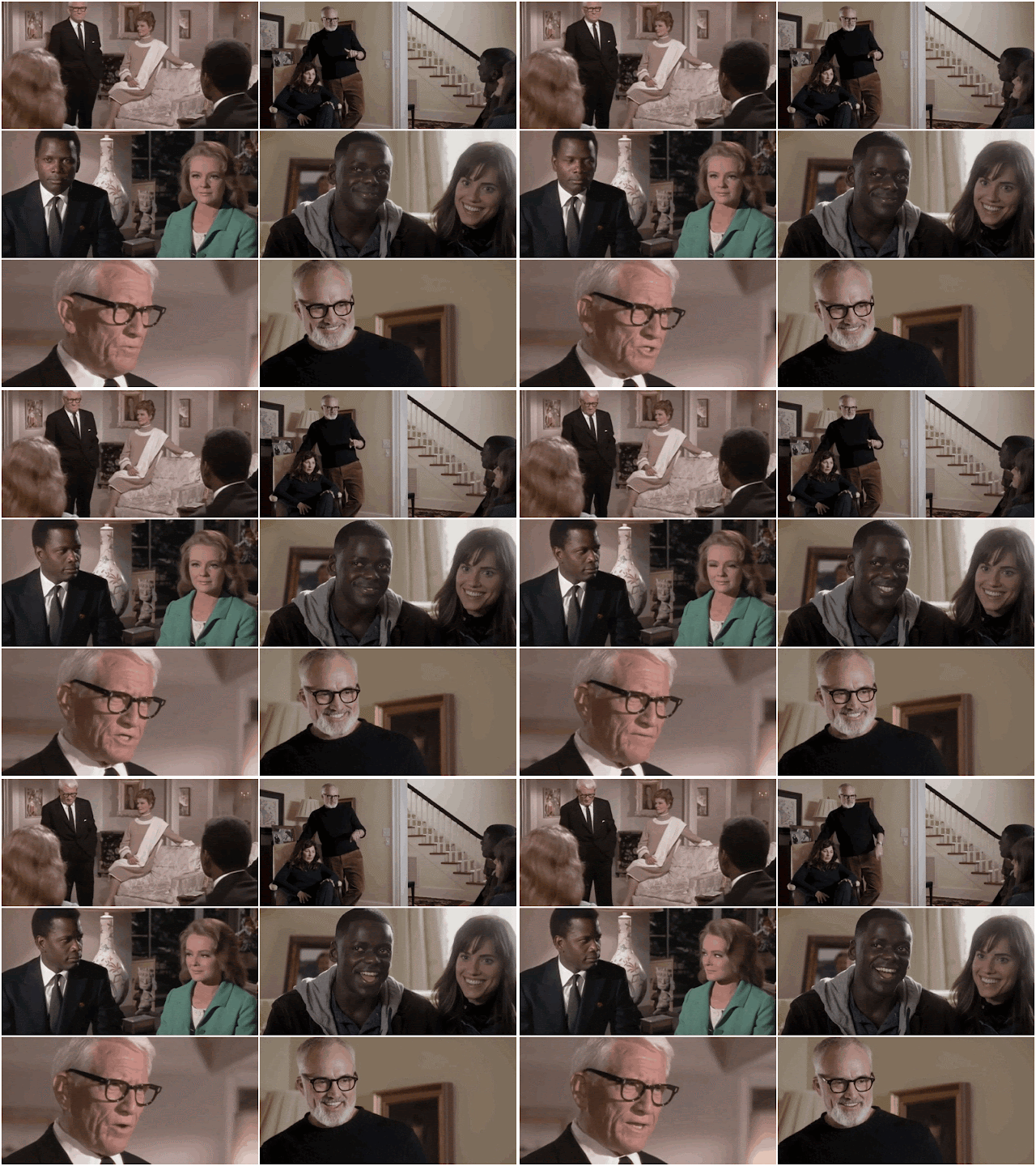
Guess Who's Coming To Dinner / Get Out


But Get Out touches on that elephant in the room that a lot of people don’t want to deal with or genuinely cant see (there are people who really think that because we had two terms of Barak Obama that we’re in a post-racial society which couldn’t be further from the truth). This film touches on the fear that some Black men have living in this country (the opening scene really hammers this home). But, generally speaking, Black men on film are often big, strong, tough and/or stoic (Idris Elba, Mike Colter, The Rock, Denzel Washington, etc). None of these are characteristics associated with fear or weakness. But Black men get scared from time to time.
A (dark) source of inspiration for Jordan Peele in writing Get Out was the Trayvon Martin murder. Based on this country’s history with Black people, it’s understandable why we (Black American males) tense up when a cop car pulls up behind us or beside us. I’ve been in situations before where I’ve literally done nothing wrong and have nothing to feel guilty about but the feeling of a cop near me just made me feel guilty. As a matter of fact, the cops "escorted" me to my friend's house in Beverly Massachusetts not too long ago (by escorted I mean I was literally tailed by a cop car for a good 10 minutes until I got to my destination).


Get Out is in no way a representation of the first time I met my fiancee’s family (they're awesome and have made me feel like family right away).
My fiancée & I have certainly had the kind of minor examples of silly intolerance that one might expect a modern-day interracial couple to experience from time to time (strange yet transparent looks from both Black people & White people), but nothing too crazy (I don’t want to present this as a sob story or anything). I’m also a large Black man so I sometimes draw attention to myself – depending on the setting – just by existing or entering a room. So, depending on the situation, a large Black man with a white girlfriend/fiancée/wife can bring on a potential double-take or a quick stare. And that stuff has certainly happened to us but I find that stuff more funny than I do upsetting. I’m too busy planning a wedding with the love of my life to worry about what someone I don’t even know/care about thinks.

And there’s a flip side to the negativity that can sometimes come along with interracial intolerance. There’s this strange immediate/on-site comradery that comes up between interracial couples. It’s like there’s a secret society of interracial relationships out there that have each other’s back. Actually that kind of sounds like a skit that Jordan Peele would have come up with for the Key & Peele show…

I don't know if I'd give Get Out a 100% rating (there are a few joke moments that validate the stereotype that Black men are easily attracted to white women simply because they're white and I found Caleb Landry Jones' performance as the brother a little annoying). I also don't think a well executed movie about race can ever be "perfect" or even almost perfect because race is a messy subject (I'm sure Jordan Peele is aware of this). But it's definitely a fulfilling movie-going experience at the end of the day

Wednesday, February 22, 2017

THE SCHOOL OF TARKOVSKY PART 6

Tarkovsky, who does not usually drink, got completely drunk and cut off the speakers at the restaurant, then began singing the theme of Seven Samurai at the top of his voice. I joined in, eager to keep up. At that moment, I was very happy to be on Earth. - Akira Kurosawa


In this latest installment of The School Of Tarkovsky we'll be looking at some more "forced comparisons" (Carlos Reygadas is on record numerous times naming Tarkovsky as a major influence) and "reaches" (Lars Von Trier was once quoted as saying he wanted to be like Tarkovsky early on in his career).

enjoy...

THE MIRROR/THE RING

THE MIRROR/STRANGER THINGS

ANDREI RUBLEV/FLESH + BLOOD

STALKER/THE ELEMENT OF CRIME

THE MIRROR/PORTRAIT OF THE ARTIST

SOLARIS/BATTLE IN HEAVEN

IVAN'S CHILDHOOD/RED BEARD

THE MIRROR/BARBARA

Wednesday, February 15, 2017

WRONG REEL EPISODE #231: ABEL FERRARA


Check me out on the latest episode of Wrong Reel alongside Chris Funderberg to discuss the work of PINNLAND EMPIRE favorite Abel Ferrara.

enjoy...


Also, dont forget to check out all the Abel Ferrara-related material on this very site...

LinkWithin

Related Posts Plugin for WordPress, Blogger...