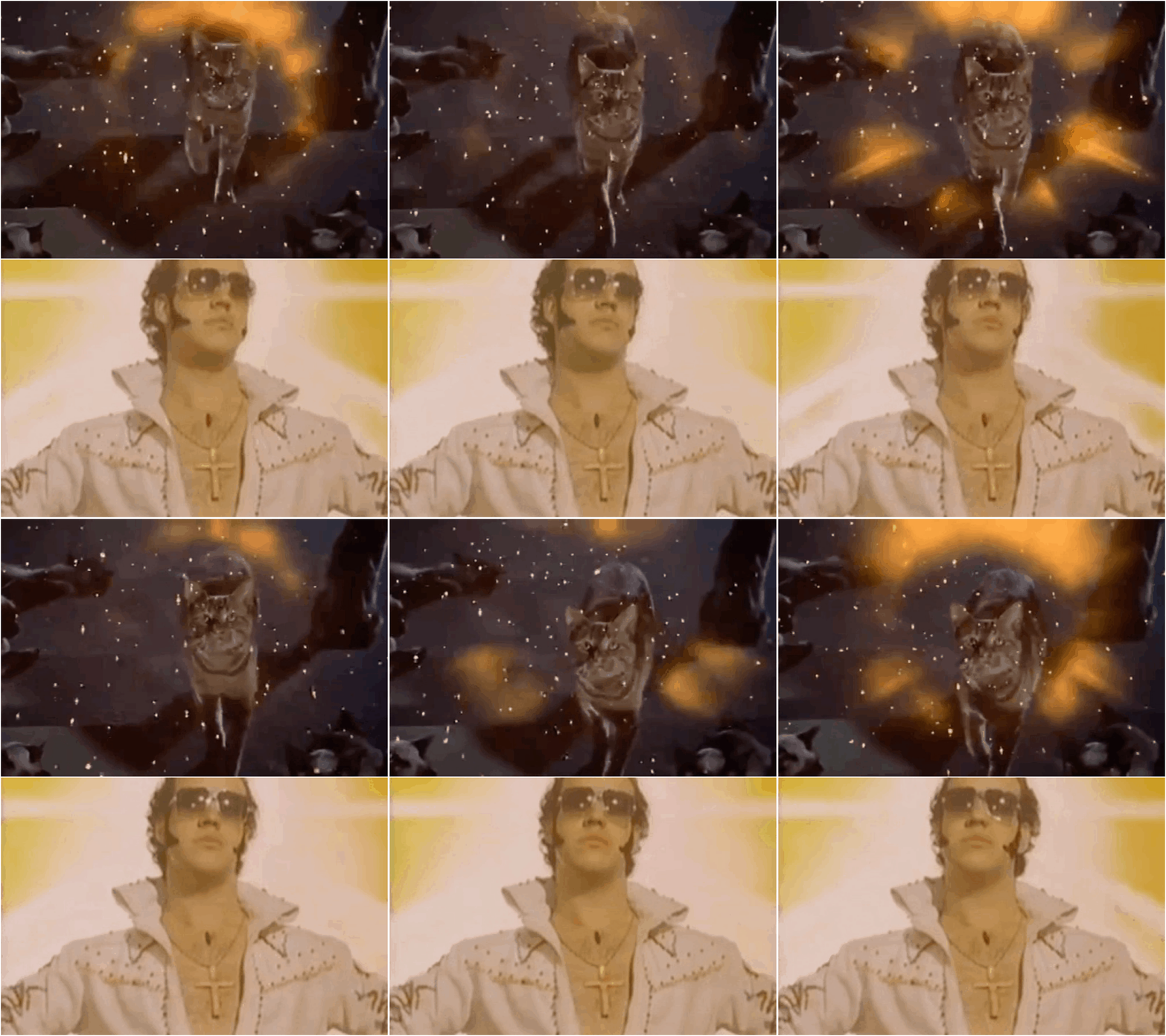
Showing posts with label the 80's. Show all posts

Thursday, May 1, 2025

PERSONAL PROBLEMS


I included this film in my recent piece over at Okayplayer.com about the modern Black Film Canon (click here to read), but I felt like going a bit more in depth over on my own personal blog. If you're exhausted with all the insufferable takes on Ryan Coogler's Sinners and are looking for an alternative perspective on Black American life - look now further than Personal Problems. But please approach with caution as this is a Black film that can't be dissected through the lens of Get Out (is it me, or does it feel like most popular modern Black films can't be analyzed unless it's through the lens of something Get Out-related?). Contrary to what the average film twitter or letterboxd "critic" will have you believe - there are plenty of Black films with stories that exist outside of the white boogeyman or "stay away from dem white women"...

In the era of the Black-led/“Black Is Beautiful” films like Beale Street, Moonlight, Dope, Nickle Boys, the discovery/re-discovery of works like Bill Gunn’s Personal Problems is a breath of fresh air. Not to take anything away from the films of Barry Jenkins & Ava Duvernay (their films do serve a purpose and have a somewhat authentic audience) but there is a little more substance to the work of Gunn. While a lot of today’s popular “Black films” don’t go beyond the surface of saying; “Black Skin & Black people are Beautiful” (which, as a proud Black person, is obviously something I subscribe to), a movie like Personal Problems delves in the complexities of “Blackness”, loyalty, infidelity, the power dynamic in the Black household and so much more (the same could be said about other older recently rediscovered Black films like To Sleep With Anger, Ganja & Hess, Ashes & Embers, etc). The more I watched Bill Gunn’s epic 2nd feature, the more I saw my parents, uncles, aunts and various 2nd cousins who used to drop on & off the grid from time to time. It’s almost like you could feel the cigarette smoke emanating off of the actors. I’m a child of the 80’s & 90’s so I remember when parents used to smoke cigarettes (...and weed) directly in to a child’s personal space. One Of my oldest memories of growing up during the 80’s in a Black household is that thick cigarette smoke, Alongside Hennessy bottles, soul music & loud laughter. Personal Problems is all of those things and more (I also relate to Personal Problems on a deeper level as my Mother & Father are from South Carolina & New York City, respectively, like our protagonist couple in the movie).

While there is a plot (the two act film centers around a Black family living in Harlem as they struggle with money, work, infidelity & death), Personal Problems is really about the banalities and authentic qualities that you cant find in most films about Lower-middle class Black America. For those of you that don’t know, Personal Problems was shot on what appears to be a camcorder which just adds to the authenticity. At times you almost feel like you're watching a mix between a documentary and a heavily improvised Shadows-era John Cassavetes film full of energy and wonderful mistakes.

Personal Problems
is a transgressive work of cinematic art that intentionally alienates some of its audience. It’s almost three hours long and the fact that it was shot on a cheaper camera brings on a whole additional chain of issues (the audio is far from perfect and it should go without saying that the visuals are quite grainy). But, in my opinion, more Black films need to be transgressive & complex as opposed to catering to the opinionated (yet often uninformed) social media audiences that just want to be spoon-fed nice & happy things (especially when it comes to movies about Black folks). I mean how often does the issue of someone’s body Oder come up in a movie in a non-comical way? We get things like that in Personal Problems because Bull Gunn delves in to the nasty crevices that a lot of filmmakers avoid.

The theatrical release of Personal Problems couldn’t have come at a better time with the universal praise of Barry Jenkin’s If Beale Street Could Talk. These two films would make an interesting double feature. Again - not to take anything away from Jenkins and his success, but at times Beale Street felt a little “Safe”. The issues in Beale Street (which come from James Baldwin’s writing) are quite real and not to be taken lightly, but the stylized slow-motion sequences and non-stop close-up shots of (beautiful) Black faces started to take precedent of the actual meat of the story. I don’t necessarily need a film (or anything/anyone) to remind me that Black is beautiful. I know this. But perhaps some folks don’t know this and need to be reminded of this from time to time (we still live in a world where Black lives don’t always matter). And that’s fine. That’s the audience for Beale Street. I like to think I represent the audience Personal Problems. There is a place in this world for both movies to exist. I just think there needs to be more complex & “difficult” films to balance out all the “safer”, “less threatening” films that focus on Black life in America.

Honestly – I’m just glad we have a new (Black) director’s body of work to include in the unofficial Black film canon that’s been curated mostly by white cinephiles and Black cinephiles who don’t delve deeper than Daughters Of The Dust and/or Killer Of Sheep. No disrespect to Julie Dash (Daughters Of The Dust) or Charles Burnett (Killer Of Sheep) but there’s a whole world of modern Black cinema out there waiting to be re-discovered and placed on a pedestal.


Monday, August 14, 2023

HOLLYWOOD SHUFFLE (ALTA JOURNAL)


The great folks over at Alta Journal had me back to write about Robert Townsend's Hollywood Shuffle in an effort to remind folks that while it is "groundbreaking" and "important", it's also funny. Very Funny.

Click here or the image above to go to the article.

Monday, August 1, 2022

A FEW MORE WORDS ON CRIME WAVE *UPDATED*

Well, I had already appeared in my short films in the central roles doing this kind of Buster Keaton stone face thing. Really, I just kept going with what I thought had been working for me - John Paizs, notcoming.com

Steamboat Bill Jr / Crime Wave


My fascination with John Paizs’ Crime Wave has bled over in to 2022 (I guess you could also say the same thing about modern Canadian cinema on a whole as I have pretty much been posting/writing about Canadian films for the last few months).

After posting my thoughts on his feature debut last year (which you can read by clicking here), I discovered even more direct & indirect visual similarities that I thought I’d share with you all.


Enjoy…


Crime Wave / The Kids In The Hall

Crime Wave / The Kids In The Hall

Bruce McCulloch (and the other Kids) really dug CRIME WAVE, and wanted to see whether my style might mesh with theirs in some of their sketches - John Paizs, theskinnymag.com

*BONUS* a similar moment between an earlier John Paizs short film and a kids in the hall sketch...
The International Style / The Kids In The Hall

Crime Wave / The Kids In The Hall

Bruce McCulloch is the reason I got involved with The Kids in the Hall. He saw CRIME WAVE on pay TV and really liked it, so he got their producers to find me. And it was very lucky for me. It really changed the course of my life - John Paizs, canuxploitation.com


The Three Lives Of Thomasina /
Crime Wave

60s live-action Disney films also had their impact, in particular THE THREE LIVES OF THOMASINA and THAT DARN CAT. I drew heavily from them for CRIME WAVE! - John Paizs, notcoming.com
That Darn Cat /
Crime Wave


I loved the Technicolor look of Rear Window [1954], Leave Her To Heaven [1945] - John Paizs, Slate
Rear Window /
Crime Wave

Rear Window /
Crime Wave

Rear Window /
Crime Wave

Leave Her To Heaven /
Crime Wave


Quite possibly Fellini's 8 1/2. I'd certainly seen it before writing Crime Wave, and it may well have influenced me, subconsciously anyway, in that regard. It does have similar kinds of fantastical interactions. And hey, it's also about writer's block! - John Paizs, Slate
8-1/2 / Crime Wave


Hitchcock’s Shadow of a Doubt was a big influence, no question - John Paizs, brooklynrail.org

Shadow Of A Doubt / Crime Wave

Shadow Of A Doubt / Crime Wave

If Uncle Charlie had murdered prose instead of widows it would have been almost the same movie! I got the whole darkness-in-a- small-town framework from that movie, plus the two Charlies' relationship has a definite parallel - John Paizs, matchboxcineclub.com
Shadow Of A Doubt / Crime Wave


Another possible subconscious Hitchcock influence appears later on in the film...

North By Northwest / Crime Wave

North By Northwest / Crime Wave


Meet Me in St. Louis has always stood out for me as a particularly evocative use of Technicolor - John Paizs, notcoming.com
Meet Me In St. Louis / Crime Wave

Monday, March 1, 2021

CRIME WAVE


John Paizs' Crime Wave (not to be confused with Sam Raimi’s Crimewave which came out around the same time) is an amazing mix of surreal humor and the deconstruction of 1950s/1960s nostalgia (noir films, pulpy crime novels, Norman Rockwell paintings, etc). It’s like an entire season of Leave It To Beaver under the creative control of Kenneth Anger. And if that doesn’t work for you, imagine a cinematic stew of everything from David Lynch & The Coen Brothers to True Stories (The Talking Heads) & the dark side of Elvis Presley’s personal life.
For those of you that are unfamiliar or visiting PINNLAND EMPIRE for the first time - I’m very much in to cinematic comparisons (both intentional & unintentional) and visual similarities. Crime Wave is all of those things and more so I was very drawn to this

John Paizs doesn’t shy away from the possibility that he may (or may not be) influential in some way...

The Coen brothers...they were sent CRIME WAVE very early on by my distributors to see if they might have any suggestions for a recut of the film or whatever - John Paizs

Crime Wave / Raising Arizona

Crime Wave / Raising Arizona


What I do know is that about five years after, they came out with their own postmodern writer’s block dark comedy, which even had its own made-up movie genre, the wrestling picture. And of course I’m talking about BARTON FINK - John Paizs

Crime Wave / Barton Fink


The basic plot of Crime Wave centers around an author (Steve) in the midst of a serious writer’s block (he only gets inspiration late at night when the street light outside his room comes on). The majority of the story is told from the perspective of a young girl (Kim) whose parents rent a room to Steve while he figures out his next book idea (Kim is both very observant and also has a huge schoolgirl crush on Steve).
But the basic premise doesn’t do the film justice. There’s a serial killer dressed up as Elvis, a horny sadistic cowboy and interludes that come right out of Ren & Stimpy. Crime Wave feels like a footnote in the development of early 90’s Nickelodeon programming (Pete & Pete, Are You Afraid Of The Dark, Ren & Stimpy, Rocco’s Modern Life, etc) or modern day Cartoon Network Adult Swim programming (Tim & Eric, The Shivering Truth, Joe Pera, Eric Andre, The Heart She Holler, etc). I think that’s what fascinates me most about this film. It’s filled with a ton of influences and it also went on to (possibly) influence later films in the same lane.

I came across this movie while I was in the middle of a serious Guy Maddin phase. Maddin has always been one of my favorite modern filmmakers but it only hit me recently how much I love his work. Reading everything I could about his early career eventually lead me to his fellow Winnipeg contemporary; John Paizs.

A young Guy Maddin appears in a few of Paizs’ early short films...

Maddin often shouts out Paizs in interviews so it only made sense to check out his films (Crime Wave is currently streaming on Amazon Prime and his excellent short film; The International Style is on YouTube). Turns out, I was familiar with Paizs’ work without even realizing it. He not only directed episodes of Kids In The Hall, but he also directed the 1999 sci-fi satire Top Of The Food Chain which I’d seen once over two decades ago as a teenager. That’s when it all clicked. Everything suddenly made sense. The same satirical approach in Top Of The Food Chain can be found in Crime Wave. The same voice-over narration (courtesy of a young girl) found in some of the skits in The Kids In The Hall sketches are rooted in Crime Wave...

The “It’s a fact girl” had to have been influenced by Kim in some way...

Crime Wave /
The Kids In The Hall


Steve’s fascination with the radiator in John Paizs’ Crime Wave (below) reminded me of Eraserhead (top), then I came to find out Eraserhead’s tone was kind of an inspiration for Crime Wave...

I’d always imagined that this would play at a midnight movie, kind of a cult movie and that this needed special handling. It needed to be directed at the same audiences that were going to see, for example, Lynch’s Eraserhead. That wasn’t part of the market that they had experience - John Paizs

Eraserhead /
Crime Wave


This branches off in to more possible Lynch connections with stuff like the cowboy in Mulholland Drive...

Mulholland Drive /
Crime Wave

Mulholland Drive /
Crime Wave


And Lynch’s cinematic first cousin (and Canadian hero) David Cronenberg also seems to have rubbed off on Paizs/Crime Wave

Videodrome /
Crime Wave


The similarities between Crime Wave and David Byrne’s True Stories are also undeniable...

True Stories / Crime Wave

True Stories / Crime Wave


I’m also reading from multiple sources about how much Paizs loved Kenneth Anger and how he inspired some of his work. It definitely shows...

Rabbit's Moon /
The International Style 

Scorpio Rising /
Crime Wave

Scorpio Rising /
Crime Wave

Scorpio Rising /
Crime Wave


The visual similarities extend beyond film & TV...


Other possible darker visual influences can be traced back to everything from Friedkin’s Cruising to the frustrated writer in The Shining...

The Shining /
 Crime Wave

Cruising /
 Crime Wave


I feel like this movie (along with everything else in Paizs’ filmography) was made specifically for me. I still can’t believe it took me this long to see Crime Wave but I guess it’s better later than never.
I do have to shoutout my friend David Davidson of Toronto Film Review who tried his best to get me to watch Crime Wave for the last 6 years...


Wednesday, February 10, 2021

DOC'S KINGDOM


The most intriguing aspect about Doc’s Kingdom is it's timeless, borderline sci-fi ambiance. Part of the reason it feels so timeless is because the majority of the film takes place in a part of the world that time has forgotten (a regional of Portugal). The movie was made in the late 1980's but it could just as easily be 1960 or 2020. It’s almost like Tarkovsky’s Stalker. Not exactly but kind of. The architecture in Doc's Kingdom doesn't look dated and there aren’t any cars or other obvious artifacts to give away the time period. The clothes worn by the actors are basic white t-shirts, simple blazers, button down shirts and khaki pants. These are clothes that could be worn at any point in time. Even the music - a progressive mixture of electronic, live instrumentation and light sampling - makes it even more difficult to pinpoint a specific year. 
All of these elements combine to form a really cool fever dream of a movie.

Stalker /
Doc's Kingdom

Stalker /
Doc's Kingdom

Stalker /
Doc's Kingdom

Stalker /
Doc's Kingdom


In addition to Tarkovsky, there also appears to be a clear Bresson reference later on in the film...

The Devil Probably /
Doc's Kingdom


While there is a lot of seemingly pointless meandering throughout the film, the basic plot is about a young man (Jimmy) who sets out on a journey across the world (from New York City to Portugal) to find his estranged father (Doc) after his mother passes away.
Doc’s Kingdom feels like a first cousin to Claire Denis’ L’Intrus. In L’Intrus you have the estranged father/son relationship, a similar timeless feel and the same overall disorienting tone. Both movies take us across the globe in the same way. Kind of like in a dream. Sometimes when you dream you find yourself in different surroundings every few minutes and you can’t remember how you got from one place to next. In L’Intrus, one minute we’re in the French countryside and the next minute we’re in Korea. Then we’re suddenly on a nameless Polynesian island (L’Intrus also kind of does a reverse Doc’s Kingdom in that the last half of the movie is about an aging man looking for his son). The connection between the two movies is even stronger to me as Doc’s Kingdom features Claire Denis regular Vincent Gallo as Jimmy.
We see Jimmy sitting on the stoop of his New York City apartment and the next minute he’s landed somewhere in another country. Again - this approach makes things disorienting but in a way that keeps your attention & curiosity (the entire second half of the movie feels like a noir as we watch Jimmy follow his father at night, peeks through windows, etc).
The science fiction element of the story has to do with Doc’s mysterious disease. It isn’t clear how he got it. The symptoms of this vague disease (which include “transparent skin”) allows your mind to wander (to bring it back to Claire Denis for a bit - the disease in Doc’s Kingdom is similar to the disease in Trouble Every Day in that they’re both vague with odd side effects).
Jimmy’s intentions in searching out Doc are unclear. Does he want to make peace and get to know his father? Or does he want to confront him for not being around? Early on in the film we learn that Doc’s shady criminal past is part of what brought him to Portugal.


I’m a sucker for movies like Doc’s Kingdom. Besides the score, Vincent Gallo’s presence and it’s subconscious connections to the aforementioned movies, director Robert Kramer uses spotty & somewhat intentionally unreliable voiceover narration similar to that of Terrence Malick (Kramer is more of a political filmmaker so he doesn't strike me as the kind of person to intentionally reference other directors, but the similarities are still there).

I don’t want to call something I just watched a masterpiece but this is an excellent film that I’ll be revisiting very soon.

Wednesday, September 19, 2018

UNDERRATED '88: SALAAM BOMBAY! & CHOCOLAT


Check out my recent contribution to Rupert Pupkin Speaks' ongoing Underrated '88 series where various critics/bloggers/film writers tackle overlooked & underrated films from 1988.
For this entry I tackled the directorial debuts of Mira Nair & Claire Denis. Click here or on the image above to read.

Enjoy...

Tuesday, August 1, 2017

THE CINEMA OF PETER GREENAWAY TOLD THROUGH IMAGES & STILLS: PART ONE (ARCHITECTURE, ART & DESIGN)


To say Peter Greenaway has an appreciation for the arts would be an understatement. A large majority of his films are loaded with overly obvious art references (A Zed & Two Noughts & The Belly Of An Architect) and sometimes not so obvious art references (Drowning By Numbers & The Pillow Book). I'm certain that if Peter Greenaway did not find cinema he would have been a painter or a sculptor. And if not that - surely he'd be an architect considering his filmography.
The Belly of an Architect may be Greenaway's only film on the subject of architecture, but his work before and after is still rooted in that profession. In The Pillow Book, Greenaway delves in to the world of calligraphy, which used to be an integral part of the architectural drafting process. Even though it's hardly practiced anymore, architects and aspiring students were once required to have excellent calligraphy skills for their drawings. In The Draughtsman's Contract, Greenaway follows an artist who's been commissioned to draw a series of landscapes. And some of Peter Greenaway's non-film/installation work is rooted in architecture (his installation piece titled; "steps" is a three dimensional large scale model of a staircase).

Not that it makes or breaks the enjoyment of his films, but if you really want to go deep in to the cinema of Greenaway you do have to have a little knowledge on the history of art, architecture & design beyond just Frank Lloyd Wright and you have to be familiar with the lesser known Rembrandt paintings to catch some of his visual references. On one hand, that is a little unfair. Why should you need pre-requisites in order to simply watch & understand a movie? Those unfamiliar with architecture, classic art or art house cinema may find Greenaway's references and name-dropping to be a tad bit elitist at times. But on the other hand, you could take that as Peter Greenaway giving his audience some credit and making the assumption that they know a thing or two about classic art or the differences between a robust column versus an oblique column.


Peter Greenaway's filmography spans over five decades so it would be too much to cram his entire body of work in to one entry. This will be the first of an on-going series (part two will focus on Greenaway's fascination with animals, the human anatomy and other various cinematic influences).


Enjoy...


ART INFLUENCE/ART APPRECIATION

I always think that art is one of the most wonderful exciting curious ways to learn. I have no worries or apologies about art being used as a teaching medium - Peter Greenaway

The Belly Of An Architect / "The Death Of Murat"
The Belly Of An Architect / Rene Magritte
The Belly Of An Architect /  "The Kiss"
The Belly Of An Architect / "The Thinker" / Atlas
The Belly Of An Architect / "The Thinker"
The Belly Of An Architect / "Tristan & Iseult"
The Belly Of An Architect / "On The Operating Table"
The Cook The Thief The Wife & Her Lover / "The Anatomy Lesson of Dr. Nicolaes Tulp"
A Zed & Two Noughts / "The Girl With The Red Hat"
A Zed & Two Noughts / untitled still-life painting
Nightwatching / "The Night Watch"
A TV Dante / Vitruvian Man
8-1/2 Women / Modular Man
Drowning By Numbers / "Preparation Of Christs Body"


RECURRING ART REFERENCE: "THE LAST SUPPER"
Top to Bottom:
The Belly Of An Architect
The Cook The Thief His Wife & Her Lover
The Draughtman's Contract
Nightwatching
Drowning By Numbers
Darwin

RECURRING ART REFERENCE: LAMENTATION OF CHRIST
Top to Bottom:
Drowning By Numbers
A Zed & Two Noughts
The Pillow Book


THE ART OF CALLIGRAPHY, PENMANSHIP & SKETCHING
Peter Greenaway has a love for freehand creation from sketching (The Draughtman's Contact & The Belly Of An Architect) to caligraphy (Prospero's Books & The Pillowbook)

Freehand is a lost art. Not a completely lost art but it’s still not as prevalent as it was decades ago. Now…modern technology (Photoshop, sketchup, AutoCAD, Revit, etc) does exist for a reason and should be utilized in the field of design because it makes creating easier. But freehand designing/sketching/calligraphy is also important because there are no limitations outside of your own mind. The aforementioned design programs are very fancy & user-friendly but they are still limited when compared to a pen & a piece of paper. 
Prospero's Books
Prospero's Books
The Draughtman's Contract
The Pillowbook
The Belly Of An Architect
Nightwatching
The Belly Of Architect
The Draughtman's Contract


ARCHITECTURE & DESIGN

Architecture is the ultimate multimedia and it creates the situation which exists for everyday 9-5 living. You can forget cinema, you can go through life without worrying about a painting, you can even impoverish your life by not listening to music, but you cannot avoid architecture. We need it; it is one of the essential elements. - Peter Greenaway

Art & architecture go hand in hand so it would only make sense that Peter Greenaway has same fascination with Architecture that he does with art (architecture is an art within itself). And like his knowledge of art history, Greenaway’s knowledge of Architecture is quite deep (I say this because I studied architecture, currently work in the design field and have a pretty good understanding of the language of cinema). It's one thing to capture a polarizing shot of an urban landscape or a beautiful modern building but Greenaway goes deeper. Instead of standalone shots of monuments, Peter Greenaway explores the support structures that hold up floors & ceilings. He knows the differences between the different types of columns (load bearing vs. cosmetic) and he knows how to shoot/capture a space created by archways, walkways & columns.

COLUMNS
Prospero's Books
A Zed & 2 Noughts
Eisenstein In Guanajuato
Prospero's Books
The Belly Of An Architect
Eisenstein In Guanajuato
8-1/2 Women


ARCHWAYS & DOMES
The Belly Of An Architect
A Zed & Two Noughts
Prospero's Books
The Belly Of An Architect
Eisenstein In Guanajuato
The Tulse Luper Suitcases
Leonardo's Last Supper


CEILING STRUCTURES
8-1/2 Women
The Tulse Luper Suitcases
Goltzius & The Pelican Company


WINDOWS
And for those that don’t know or are in denial, windows are very much an intricate part of architecture as well...
Windows
The Belly Of An Architect
Windows
A Walk Through H
A Zed & Two Noughts


RECURRING SHOT: GRID LINES
Gridlines give me the subconscious visualization of graph paper which then takes me to the idea of designing (architecture), drawing, (art), space planning and the general idea of creating something. His use of gridlines & framing (which we’ll get in to next) is sometimes obvious & on the nose (The Falls) and other times unconventional & clever (The Draughtsman’s Contract).
The Draughtman's Contract
The Falls
A Zed & Two Noughts
The Falls
The Falls
A Zed & Two Noughts
A TV Dante


Speaking of framing…


RECURRING SHOT: FRAMING
The way Peter Greenaway frames his actors (and sometimes pieces of actual art) gives us a subconscious sensation of being in an art gallery...
A Walk Through H
A Walk Through H
A Zed & Two Noughts
The Draughtman's Contract

Greenaway’s signature frame-in-frame in shots…
Prospero's Books
The Pillowbook
The Tulse Luper Suitcases


MIXED MEDIA & EXPERIMENTATION OUTSIDE OF "TRADITIONAL CINEMA"
Peter Greenaway is more than a filmmaker. He is a VJ, a visual artist (“Leonardo’s Last Supper”), a mixed-media hobbyist (“Long Live The Cinema/Death To The Cinema”) and a designer (“The Steps”)
"Leonardo's Last Supper"
Peter Greenaway "VJing"...
One of Peter Greenaway's many multi-media art installations...
A shot from "Long Live The Cinema"/"Death To The Cinema"
Greenaway utilizing multiple screens during an art installation
"The Steps" (a structure designed by Peter Greenaway as part of an art installation project)


LinkWithin

Related Posts Plugin for WordPress, Blogger...