Showing posts with label Dreyer. Show all posts

Monday, June 1, 2026

THE TESTAMENT OF ANN LEE


The Testament Of Ann Lee certainly passes the look test. It’s what some might call visually stunning but it kind of lacks in the typical substance that one might expect from a biopic. Now…I don’t think director Mona Fastvold was trying to make a typical biopic so perhaps this criticism doesn’t concern her. As flawed as this movie is, I find it interesting (interesting can be a good thing). It's part biopic, part dance/performance piece and part musical.
In my personal opinion, this is the perfect response to Greta Gerwig’s Barbie. Both movies exist on some kind of a feminist spectrum, but Ann Lee is able to do so without all the surface-level “girl power”/“men are dumb simple creatures” messaging that the Barbie does. Another big similarity between the two films is that both movies are centered around female characters that have no interest in sex or romance. Ann Lee preached heavily about celibacy and Gerwig’s Barbie rebelled against the idea of the title character being the romantic interest of Ken. 
A big difference between the two films is The Testament Of Ann Lee doesn’t really think about men in comparison to Barbie. One could argue that Barbie accidentally centers the male characters at certain points. Think about it - Ryan Gosling's performance as Ken is just as synonymous with the Barbie movie as Margot Robbie. Amanda Seyfried completely carries this Ann Lee biopic. There are male co-stars but none are as memorable or as important as her. I appreciate that approach. Barbie tries to provoke and lightly troll a particular type of male at times ("film bros", misogynists, women-haters, loudmouths, jerks, etc). Ann Lee doesn't really concern itself with men. There’s nothing more silly and pointless than putting in a lot of effort to troll a group of people that already can't stand you or don't care what you do. We've reached a point where changing the gender or the race of a character in a story is done mostly now to annoying and poke at people rather than to make a genuine piece of art. There's nothing worse than grown adults like Ben Shapiro or Matt Walsh crying over updated iterations of things like The Little Mermaid or Harry Potter using female, trans or Black actors. But at the same time, I can't stand people who can only approach art from the standpoint of just bothering or annoying someone. How old are we??
The Testament Of Ann Lee certainly shows the evil that men do while still making women the center of the story. It should also be noted that the different religious sects that the movie focuses on are all based in the belief that the second coming of Christ will be a woman.

I don’t have a "fragile male ego" either. If you think men are big dumb children - fine. Just stand ten toes down on your opinion. Don't dip your toes in and out. Don’t pander to septum nose ring twitter and instagram moms that lie about their life being hard when it isn’t if you only half-heartedly feel that way. It’s phony and disingenuous.

Barbie / The Testament Of Ann Lee

I don't think any of this was intentional but even the moment where we are introduced to Ann Lee's husband is right out of the scene in Barbie where Ken first tries to dance with her...

Barbie / The Testament Of Ann Lee


To Be Clear - I enjoyed Barbie overall but a big portion of that movie plays out like it was made for people that like to mindlessly retweet and reshare lighthearted surface-level “men are dumb” posts all while adoring their husbands and wearing “boy mom” shirts. Hating men and/or thinking they’re trash is perfectly fine I guess. Just be genuine about it. I respect folks that claim to dislike men as long as they really live that life. If it’s just your online persona or something you like to profess only when you’re around other women, then you’re just corny and pandering for nothing.
 

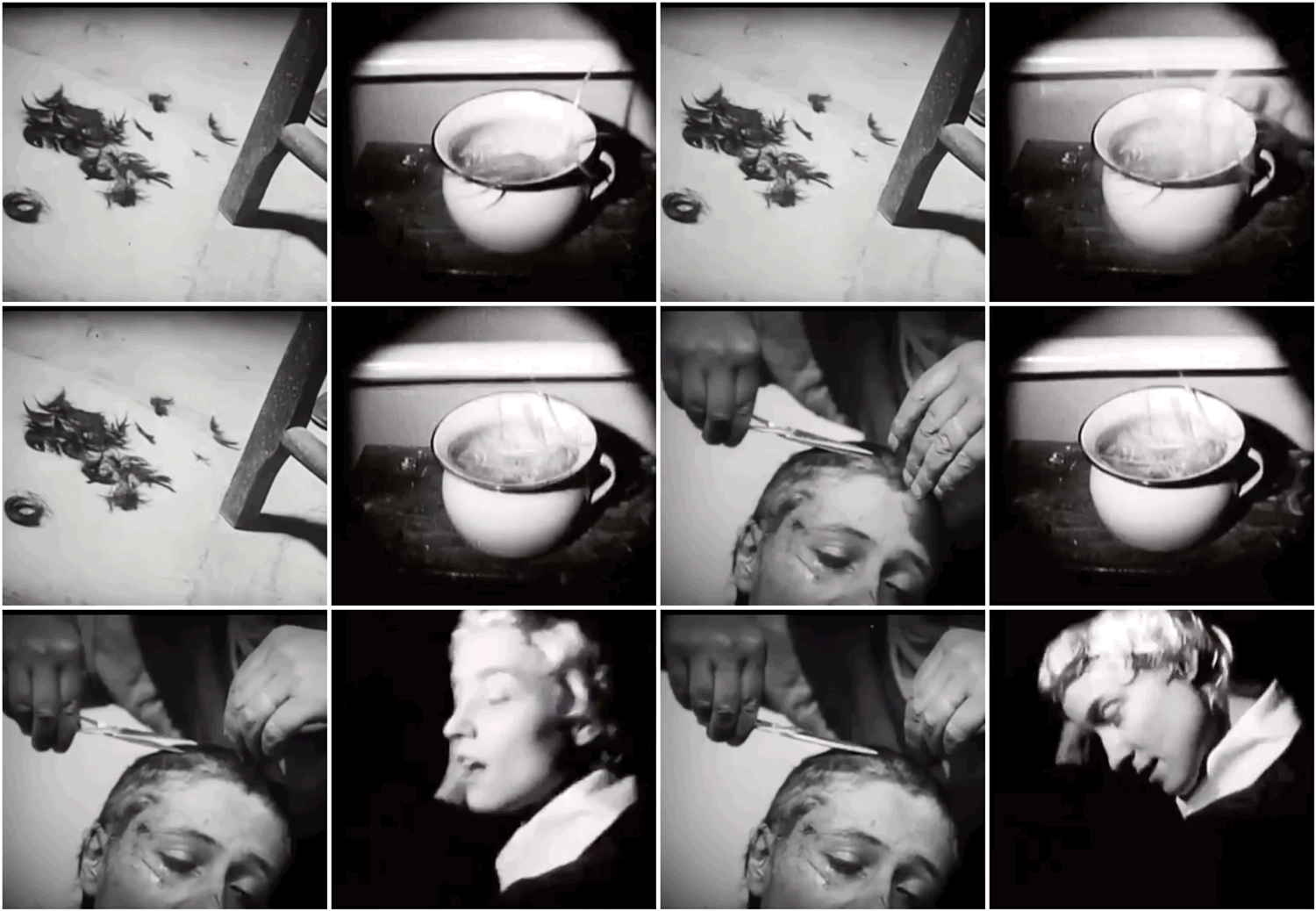
The Passion Of Joan Of Arc / The Testament Of Ann Lee

If I had to compare Ann Lee to something else - I’d say it’s very "Robert Eggers-coded". Eggers is a heavily influenced director himself and he hasn’t done or created anything new in cinema, but I don’t know if there would be a lane for this movie to exist right now without semi-recent stuff like The Witch or The Northman.
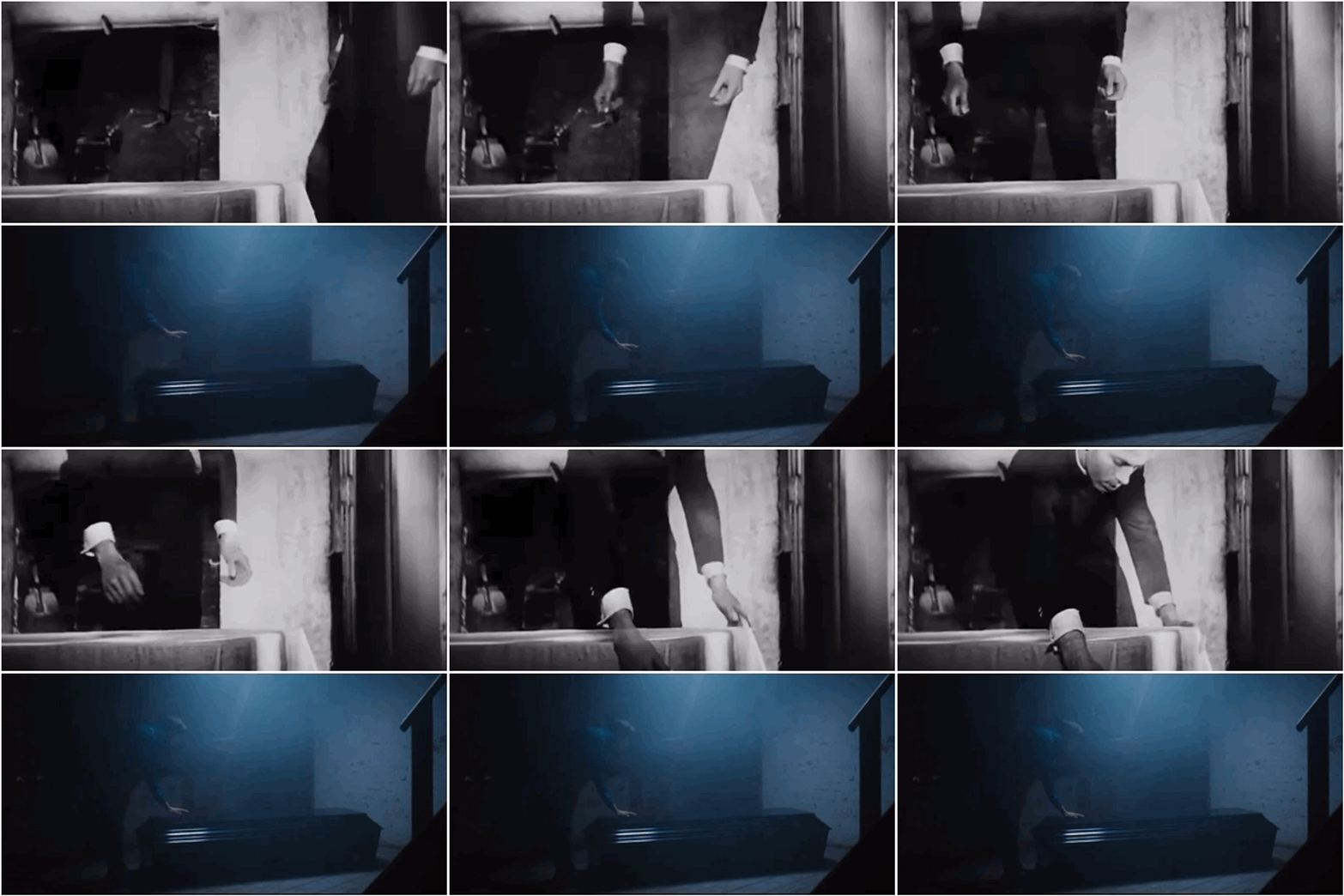
And, similar to Eggers' films, Ann Lee has some light Dreyer imagery. While they aren’t identical in any way, the funeral scenes at the end of both films are kind of similar to me (minus the resurrection in Ordet). 

Ordet / The Testament Of Ann Lee


A big flaw with this movie is the weird run time and all the history that is skipped over. This is a highly speculative retelling of the life of Ann Lee - an influential figure in the evangelical movement during the mid-late 1700s. The film starts at her birth and ends with her death which was brought on from complications of a physical attack. In between, we follow her religious journey from joining the Quakers to branching off to the Shaking Quakers to forming her own religious sect; The Shakers. There’s a lot of religious and world history to cover in her story. I wouldn’t have been mad if this was a mini-series or a show on a streaming service for the story to flesh out more (the movie also has voiceover narration that feels like it was tacked on after the fact in order to make it easier to follow).
You should never expect a biopic to capture and address everything, but this movie has the time to drag out elements that aren’t all that necessary while speeding through entire periods of Ann Lee’s life that are incredibly important (her various times in jail, the loss of all her children, her travels outside of just New England, etc). The Testament Of Ann Lee has a runtime of 2 hours and 17 minutes which is such an odd length for a movie. I’ve been saying this since the start of this blog but a biopic needs to be an 85 minute film focused on a specific isolated period of time or it needs to be a minimum of three hours if we’re going to cover someone’s entire life like this movie does. The same core team behind this movie was also behind the almost four hour Brutalist. I wonder why Ann Lee wasn’t fleshed out the same way The Brutalist was. I would have loved to see this movie take the same approach as Peter Watkin's Edvard Munch.


I don’t really like this movie but I'm glad that it exists because it can’t be digested or critiqued by simple-minded disingenuous folks like Ben Shapiro or Matt Walsh. Male and male-centered critics that want to preemptively tear apart a movie for having feminist ideals or not making men the centerpiece can’t really process something like The Testament Of Ann Lee because it doesn’t have an evil central male character to represent all men. Again - this movie is very flawed to me but I'm glad it exists.

Tuesday, July 1, 2025

BRAND UPON THE BRAIN


Much like My Winnipeg and Cowards Bend The Knee, Brand Upon The Brain serves as a personal journal for Guy Maddin. On one level we’re watching him work out some unresolved childhood traumas. The basic premise of the film concerns a young man (“Guy”) returning to the orphanage he was raised in to confront his past. On another level, Brand Upon The Brain is another Guy Maddin cinematic collage in the vein of something like Pulp Fiction where he proudly and openly wears his cinematic influences on his sleeve.
As much as I love this movie, there isn’t much to say about it that hasn’t already been said in previous posts (click here & here to my thoughts on My Winnipeg and Cowards Bend The Knee). I’m just using this post as an excuse to share all the cinematic comparisons I’ve made that have been wasted on twitter over the years (I’m permanently shadowbanned so almost no one sees what I tweet anymore). 

It makes sense that Maddin is so heavily influenced by David Lynch (click here to read more). If you watch Lynch’s early short films you can see a lot of premature ideas that would eventually turn in to features like Eraserhead, Lost Highway and Inland Empire. The same applies to Guy Maddin. Maddin will make a short film but will still cut & paste the same shots or lines of dialogue in to his features. Lynch revisits a lot of same territory over and over from a slightly different perspective. Lost Highway, Mulholland Drive and Inland Empire are almost the same thing with different actors and slightly different approaches. Lynch has gone back in to the Twin Peaks universe multiple times over the last 30 years and the protagonist in The Grandmother looks quite similar to Robert Blake’s mystery man in Lost Highway
The Grandmother / Lost Highway


Maddin is always referencing his childhood (My Winnipeg & Brand Upon The Brain), his loyalty to Canada (Cowards Bend The Knee and Saddest Music In The World), his not-so hidden sexual perversions and his love of David Lynch.

he [David Lynch] is kind of doing what painting has been doing for years, and I’m not saying that his images are painterly, but that he is doing with narrative what painting does - Guy Maddin, ScreenAnarchy.com


The cinematic collage aspect in Brand Upon The Brain extends way beyond Lynch. I don’t want to repeat what I’ve already shared (click here to read my post on the connections between Lynch and Maddin). Maddin pulls from Bunuel, Fellini, Dreyer and Murnau.
The Passion Of Joan Of Arc / Brand Upon The Brain

L'age D'or /
Brand Upon The Brain


my first inclination was to kind of remake Fellini’s I VITELLONI - Guy Maddin, Slant Magazine
I Vitelloni / Brand Upon The Brain


I watch a movie and I pretend Luis Buñuel is sitting beside me - Guy Maddin, TheAVClub.com
The Criminal Life Of Archibald de la Cruz / Brand Upon The Brain

Un Chien Andalou / Brand Upon The Brain

Mexican Bus Ride / Brand Upon The Brain

The Criminal Life Of Archibald de la Cruz / Brand Upon The Brain


I feel kind of Buñuelian - Guy Maddin, Offscreen.com
The Criminal Life Of Archibald de la Cruz /
Brand Upon The Brain

Un Chien Andalou /
Brand Upon The Brain


I love Murnau more than anything - Guy Maddin, The Columbia Journal
The Haunted Castle / Brand Upon The Brain


Brand Upon The Brain is most definitely not an intro or even a mid-level Guy Maddin film. It's jumpy, chaotic, silent and intentionally schizophrenic. If you can make it through stuff like Saddest Music In The World or My Winnipeg, then this should be the next level.


Saturday, February 1, 2025

THE INHERITANCE


I’ll be the first to admit that I sometimes feel intimidated to write about certain specific movies that I consider to be great. These occurrences are few and far between (as they should be), but sometimes a film is so good there’s almost nothing to say outside of recommending it to as many people as possible. You can only gush about a movie so much until it starts to sound cringey. In this current age of Letterboxd/film twitter movie comedians, it’s sometimes difficult to tell if someone genuinely loves a movie or if they’re just being hyperbolic to try and get laughs & attention. If a movie is truly great I don’t think there should be any memefication involved. Ephraim Asili’s The Inheritance is one of those movies. For the last 4-1/2 I’ve been singing it’s praises on podcasts and all forms of social media, but I haven’t put down any substantial words (this movie was at the top of my best of 2020 list a few years ago). The story of The Inheritance may sound like it was made for a very niche audience within a subgenre of people, but I honestly believe it can be “appreciated” by anyone. The basic story of a group of pan-Africanists in west Philadelphia that set out to make their own isolated collective/community away from the rest of the world sounds very niche and specific. But this movie tackles/touches on/circles around issues like white supremacy, separatism, gun ownership/gun control, the creation of art, activism, the deconstruction of traditional education, and more (a big part of this film’s identity is connected to the Move bombing that took place in Philadelphia four decades ago). Everyone from disingenuous Fox News-watching “conservatives” to pretentious surface-level twitter liberals that would call the police on the same Black folks they claim to care about can find something important to hold on to in The Inheritance (anyone notice how a lot of today’s so-called MAGA folks and certain sectors of modern-day pro Black folks have a lot more in common than they care to admit?)
Strangely enough, the one audience that might take issue with this movie is the growing cult of Foundational Black Americans that believe in delineation between Black Americans and Africans & Caribbean (I don’t want to get too much in to FBAs but if you’ve ever wanted to go down a very strange internet rabbit hole – look in to them). This movie is truly pan-Africanist and doesn’t promote delineation between Black people. 

If you’re just a film enthusiast then you might appreciate all the homages and visual callbacks to folks Ousmane Sembene & Jean Luc Godard...


Stylistically, the film is deeply influenced by Jean-Luc Godard’s La Chinoise (1967). When I first got around to watching the film in grad school, I was floored - Ephraim Asili, Artforum
La Chinoise / The Inheritance

La Chinoise / The Inheritance


I first encountered Sembène in film school and was struck by his powerful critique of Senegalese society - Ephraim Asili, criterion
Black Girl /
The Inheritance


Asili also namedrops Dreyer & Bresson as sources of inspiration but those are more spiritual rather than visual…

One Big influence was Robert Bresson, who was influenced by the minimal set design of Carl Theodore Dreyer films. I would ask myself ‘what connotes a kitchen, or a living room' and leave the design there – Ephraim Asili, Bomb Magazine
Ordet /
Pickpocket /
The Inheritance

Ivan Dixon's The Spook Who Sat By The Door was another source on inspiration on Ephraim Asili (a Spook poster can be seen in the background of The Inheritance). 


 I’m using terms & phrases like “appreciate” or “find something to hold on to” rather than “enjoy” because I genuinely don’t think this was made to be “enjoyed” in the traditional sense. This isn’t a traditional movie. A big part of what makes The Inheritance so unique is that it’s almost uncategorizable. On one hand it’s very serious and sometimes traumatic. But other times the movie is incredibly lighthearted, sweet and funny. It also doesn’t really fit in to a specific category or genre. It’s a hybrid scripted narrative/documentary that plays with reality & fiction.


There’s a nice-sized audience of Black film enthusiasts that claim to want something “different” and/or “challenging” that isn’t some remix of Jordan Peele’s Get Out. Well – here it is (hopefully you'll see that this movie can also serve as a gateway to so many different lanes & avenues of cinephilia). The inheritance can be streamed on Apple TV, Amazon Prime and Grasshopper films. It isn’t 1999. Folks can’t keep using the excuse that a movie didn’t come to their city or small town. Thanks to streaming (and even file/torrent sharing), independent/”art house” films are now easier than ever to see. Instead of complaining on twitter about how there are too many slave movies, you could do some very basic surface level exploration and find a world of Black cinema that might cater to your needs. 

Sunday, January 8, 2023

A FEW (POSSIBLE) VISUAL REFERENCES IN COPENHAGEN COWBOY

Vampyr /
Copenhagen Cowboy


Putting aside the obvious (and sometimes tired) modern visual references often associated with Nicolas Winding Refn (Mann, Friedkin, Argento, Refn himself or any filmmaker that’s utilized a neon light or synthesizer), I noticed a handful of slightly deeper visual references in his latest project; Copenhagen Cowboy.

I’ll be going back to watch the series again and will update this post accordingly. But in the meantime please scroll through the first wave of comparisons I came up with along with various interview excerpts from over the years to add some context and/connective tissue.


I’m not a film analyst but most of the things we do nowadays, also in advertising, lead back to Kenneth Anger’s work - Nicolas Winding Refn, Indiewire
Lucifer Rising /
Copenhagen Cowboy

Scorpio Rising /
Copenhagen Cowboy

Vampyr has always reminded me of a mysterious dream I once had when I was very little. The film has always stayed with me. I watch it before I make every film - Nicolas Winding Refn, Criterion

Vampyr /
Copenhagen Cowboy

Vampyr /
Copenhagen Cowboy


I offered to read the tarot for him [REFN] and from then on he had me read his tarot every time he made a new movie - Alejandro Jodorowsky, Vulture

Holy Mountain /
Copenhagen Cowboy

Holy Mountain /
Copenhagen Cowboy


Unique, brilliant, fantastic! I love this movie! - Nicolas Winding Refn on Tokyo Drifter, Criterion

Tokyo Drifter /
Copenhagen Cowboy

Tokyo Drifter /
Copenhagen Cowboy

Tokyo Drifter / Copenhagen Cowboy

Tokyo Drifter /
Copenhagen Cowboy

Tokyo Drifter /
Copenhagen Cowboy


For me, Night of the Hunter has always been one of the greatest horror film titles. It is truly a very frightening fairy-tale - Nicolas Winding Refn, Moviemaker Magazine

Night Of The Hunter /
Copenhagen Cowboy


film is such an early medium in a way. You know what I mean? If you go through the history of painters, you can always say that somebody was inspired by someone to do that or to do this, and of course, it's the same thing with film. Every art form is an exchange to someone else, whether it's generational, whether it's of an experience, of an opportunity - Nicolas Winding Refn on influence of David Lynch, nrftsjournal

Lost Highway /
Copenhagen Cowboy

Lost Highway /
Copenhagen Cowboy

Lost Highway /
Copenhagen Cowboy


He [Terrence Fisher] was a very interesting film director and I think very much undervalued - Nicolas Winding Refn, mubi

Flesh For Frankenstein /
Copenhagen Cowboy


Seeing The Shining is like watching a painting of pure terror. It has no purpose, sexuality or function other than to completely terrorize you - Nicolas Winding Refn, Moviemaker Magazine

The Shining /
Copenhagen Cowboy

The Shining /
Copenhagen Cowboy

The Shining /
Copenhagen Cowboy


Snatch /
Copenhagen Cowboy

Pigs & Battleships /
Copenhagen Cowboy


Hannibal /
Copenhagen Cowboy


Flesh For Frankenstein is the only film I’ve ever wished that I had made - Nicolas Winding Refn, Criterion

Flesh For Frankenstein /
Copenhagen Cowboy


He [Terrence Fisher] was a very interesting film director and I think very much undervalued - Nicolas Winding Refn, mubi

The Curse Of Frankenstein /
Copenhagen Cowboy

The Curse Of Frankenstein /
Copenhagen Cowboy


This is Suzuki at his most extreme — the flabbergasting pinnacle of his sixties pop-art aesthetic - Nicolas Winding Refn, indiewire

Branded To Kill /
Copenhagen Cowboy


the ultimate cocaine movie - Nicolas Winding Refn, mubi.com

Suspiria /
Copenhagen Cowboy


LinkWithin

Related Posts Plugin for WordPress, Blogger...