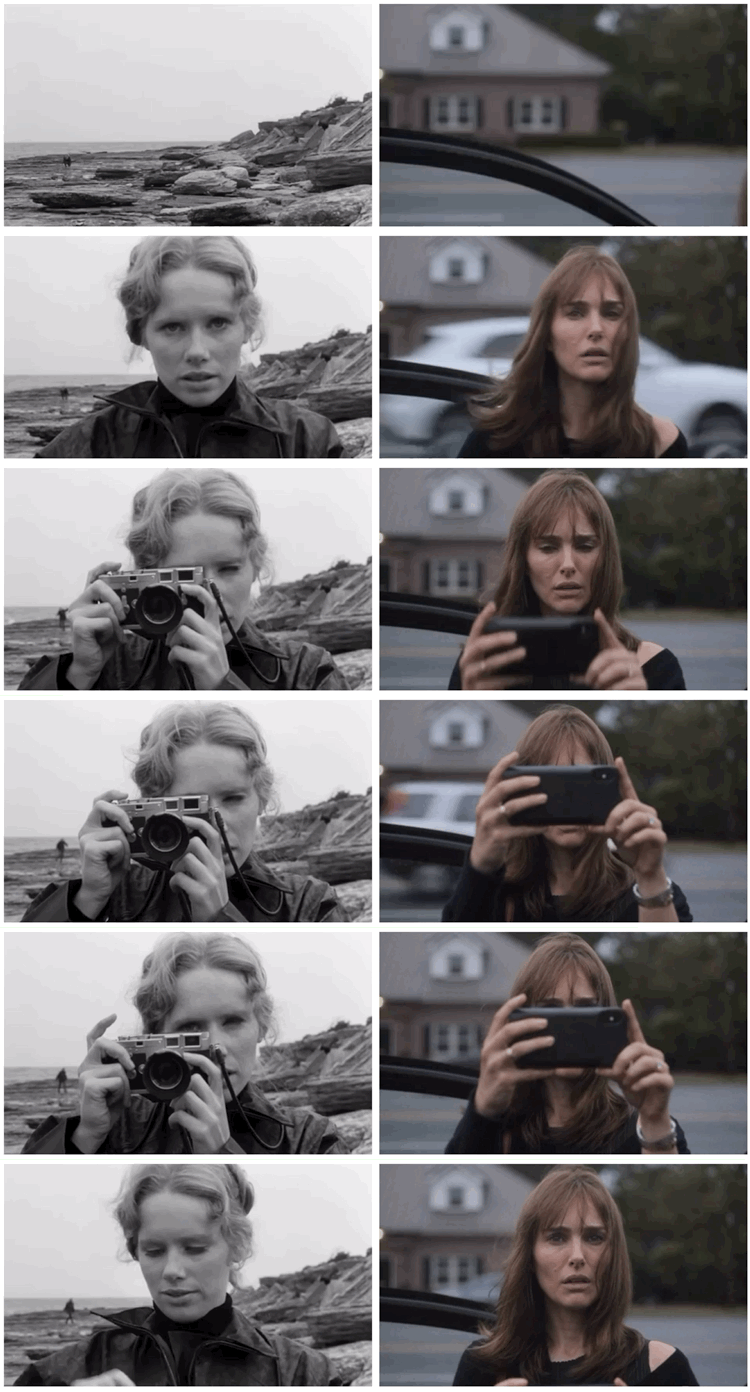
I couldn’t not think of Persona when I first read Samy’s script, in the clear way that it’s such a unique example of a film that pairs these two women and where likenesses are being exchanged, or that one character is learning about the likeness of the other and trying to incorporate her into her process as an actor - Todd Haynes, Letterboxd
'
Persona / May December
I caught a handful of Persona-esque shots in Todd Haynes May December only to discover afterwards that it was intentional (click here to learn about Haynes' influences on his latest film). Normally, a filmmaker being influenced by one of Bergman's most recognizable films seems like low-hanging fruit but this is the first time Haynes has been so open about Bergman's influence (he usually draws from the likes of Chantal Akerman, Douglas Sirk, etc).
Below are all of the worthwhile references/similarities I caught (some super obvious and others not so obvious).
And in Persona, Liv Ullmann plays an actress who’s been stricken with stage fright and has stopped speaking. Bibi Andersson is a nurse and a caretaker, called in to look after her - Todd Haynes, Letterboxd
Persona / May December
That shot figures into the film Persona, but it’s not necessarily the shot you think of when we all think of Persona. The ultimate shot is where these two are almost playing as if they’re in a mirror, and their gaze turns to the lens of the camera. It’s like a dream - Todd Haynes, Letterboxd
Persona / May December
Persona did influence that scene directly - Todd Haynes, Letterboxd
We took a little break from this but we're back looking at some of the visual similarities between Tarkovsky and filmmakers ranging from Claire Denis to Shane Carruth.
It's easy to just blindly say how influential Chantal Akerman is/was. It's another thing to give concrete examples of her influence. Below are a few examples of her influence on modern film straight from the mouths of the filmmakers who took/borrowed from her.
Enjoy...
Its loose story of a journey seems inspired by (and comes to close to sharing the philosophy of) Chantal Akerman’s Les Rendezvous d’Anna - David Gregory Lawson on Linklater's It's Impossible To Learn To Plow By Reading Books
(Linklater sites Akerman as an influence on his work on the commentary track of the Criterion disc for It's Impossible To Learn To Plow By Reading Books)
Saute Ma Ville / It's Impossible To Learn To Plow...
Les Rendezvous D'Anna / It's Impossible To Learn To Plow...
Je Tu Il Elle / It's Impossible To Learn To Plow...
She made films which meant a lot to me at the time. She was already a heroine in the cinema world - Claire Denis
Les Rendezvous D'Anna/ Chocolat
Toute Une Nuit / U.S. Go Home
Toute Une Nuit / 35 Shots Of Rum
Les Rendezvous D'Anna / 10 minutes older
No doubt Jim Jarmucsh was taking notes - Scott Tobias on Akerman's (possible) influence
Nothing is original. Steal from anywhere that resonates with inspiration or fuels your imagination. Devour old films, new films, music, books, paintings, photographs, poems, dreams, random conversations, architecture, bridges, street signs, trees, clouds, bodies of water, light and shadows. Select only things to steal from that speak directly to your soul. If you do this, your work (and theft) will be authentic. Authenticity is invaluable; originality is non-existent. And don’t bother concealing your thievery - celebrate it if you feel like it. In any case, always remember what Jean-Luc Godard said: “It’s not where you take things from - it’s where you take them to. - Jim Jarmusch
Je Tu Il Elle / Stranger Than Paradise
News From Home / Permanent Vacation
Saute Ma Ville / Stranger Than Paradise
Seeing Jeanne Dielman for the first time was just a formative jolt of inspiration - Todd Haynes
Far From Heaven is the ONE Todd Haynes film I've always had conflicted feelings about. Even with my limited knowledge about Bob Dylan (and by limited I mean almost none) I’m able to enjoy I'm Not There as it was kind of a return to his early 90's style of light experimentation like with Poison & Dottie Gets Spanked. I own Far From Heaven on DVD and always find myself watching it at least once a year which always leads me to questioning as to whether or not I like it. It’s the one work in his filmography that sticks out the most because at the time of its release this was the first film of his to receive major recognition. I remember when this came out I though; 'Did Todd Haynes just sell out?" (of course he didn’t sell out). Haynes used elements from every one of his previous films and incorperated it in to Far From Heaven. The repressed homosexuality of Dennis Quiad's character is the same as the young Christian Bale character in Velvet Goldmine or the lead actor in "Homo" (Poison). The somewhat "empty"/flighty housewife played by Julianne Moore in Far From Heaven has many similarities to Carol (also played by Moore) from Safe. And the seemingly "leave it to beaver-esque" 1950's setting is similar to Dottie Gets Spanked. It’s almost as if Dottie Gets Spanked and Far From Heaven take place in the same universe. And if not that, the story of Steven in Dottie Gets Spanked could very well be the back story of Dennis Quiad's character in Far From Heaven.
This was Hayne's first (and to this day only) exploration in to racism and the taboos of interracial relationships during a time when it wasn’t really possible. Drawing inspiration from Rock Hudson and Jane Wayman in All That Heaven Allows (a love story about an older woman and a much younger man), Haynes took that story and replaced age with race, similar to what Fassbinder did with Ali: Fear Eats The Soul. And the fact that Far From Heaven, a film partially about repressed homosexuality in the 1950's, is a loose adaptation of a movie that starred Roc Hudson kind of adds an additional subconcious layer to the movie's atmosphere. Far From Heaven is pretty to look at, features great (and underrated) performances from Dennis Quiad and Dennis Haysbert, and it references the work and overall style of great filmmakers like Fassbinder and Douglass Sirk. And at the end of the day Far From Heaven is one of the few “mainstream” films to try and bridge the gap between race & homosexuality.
Opening & Closing Credits from Far From Heaven (L) and All That Heaven Allows (R)
Far From Heaven is about a 1950's New Haven housewife ("Cathy", played Julianne Moore) who has recently discovered that her husband ("Frank", played by Dennis Quaid) is a closeted homosexual who has to seek treatment to "cure" his homosexuality. At the same time Cathy is starting to develop romantic feelings for her black gardener ("Raymond", played by Dennis Haysbert). These two intercrossing stories bring up many questions and concerns: Is it worth expressing you love for a black man in a time/era when you know it won’t be accepted? Is Cathy more concerned about the fact that her husband is unfaithful or does she care more that he's been unfaithful with men? When she walks in on Frank kissing another man she isn’t upset at all. She's confused and almost scared. This isn’t the typical reaction of a wife walking in on her husband with someone else. Sure there's exceptions but generally speaking, she reacted more to the homosexuality than the infidelity. Haynes intentionally shows racism & homophobia (the two main issues in the film) quite differently. The racism is more out in the open and accepted whereas homosexuality is only hinted at. There's moments of racism like intentionally visible black servants, terms like "boy" thrown around, and there's even a scene when Raymond's daughter is the victim of a racist attack by a gang of white kids. But to my knowledge at no point is the word "Gay" or "Homosexual" used by any of the characters in the film yet it’s all around them. In conversation, the characters stop themselves mid-sentence or say stuff like "he's...ya' know..." (obviously implying that someone is gay). There's that quick moment in Safe where two women have a conversation about homosexuality without hardly saying anything. Haynes even gets a little bold (for a white director at least) and shows black on black bigotry in Far From Heaven. Setting the film in New Haven is an interesting choice. For me, films that deal with racism set in seemingly harmless/neutral places like Connecticut, Maine or even somewhere in Canada are a breath of fresh air. I think most people understand by know that the racism in the south is on another level. The northeast doesn’t have the same history as the south so it’s interesting to see racism somewhere besides Mississippi or Alabama. Similarly, it’s interesting to see homosexuality shown in the 1950's instead of today's homophobic environment. Homosexuality was kept so hush-hush back then because of those generic American family values that you'd think it didn’t exist. Shit, people thought it was a "disease" back then.
Not only does Todd Haynes pay homage to Douglass Sirk's use of rich, bright colors (All That Heaven Allows), but he blends the actors in to the environment. Notice the red train train lights in the background behind Julianne Moore (wearing her red jacket and gloves) or her hair and how it kinda blends in to the background, as well as Dennis Haysbert's jacket and how it subtly camouflages him in with the leaves...
My two issues with Far From Heaven have to do with Raymond's naivety and the way Frank is portrayed in the story. Todd Haynes goes out of his way to show that Raymond is an intelligent & sophisticated man who's aware of his environment. Given that he's such a wise human being, why would he do some of the things he's does in the film out in the open like aggressively grab a white woman's arm on a crowded (mostly white) sidewalk? Why would he essentially take a married, well known white woman on a "date" or the world to see? That kind of stuff just doesn’t add up to me. I know love is strong and can make us impulsive but that still doesn’t jive with Raymond's character. He acts as if it’s no big deal to stroll around town out in the open with a white woman in 1950's America. And speaking of love, I can never make up my mind if Raymond is even in love with Cathy to begin with. It’s obvious she's head over heels for him (almost in a curious/fetishist way), but sometimes Raymond seems like he just wanted a friend. Am I the only one who picked up on the disconnect between those two characters?
Frank is a little more complicated (both in a good way and a bad way). Todd Haynes took the stereotypical American male who occasionally slaps his wife when she gets outta line and made him gay. Technically Dennis Quaid is "A-list" and has been in his share of great movies but when you think of your favorite actors, chances are his name isn’t going to come up these days. Far From Heaven is by far his greatest performance. And it goes beyond the fact that a straight actor stepped outside of his comfort zone and portrayed someone gay. There's plenty examples of gay performances that were a bit overrated just because they were portrayed by straight actors but Quaid was great. His aggression, his repression, the scene at the end when he breaks down and cries in front of his family...everything. All that stuff I liked very much. But at the end of the day he's portrayed as a spineless snake (especially in the last scene when he talks to Cathy on the phone). I know it wasn’t Todd Haynes' intention to show a gay person in that light (after all, he's openly gay), but is this homophobic world we live in that already hates gay people to begin with ready for such a spineless, cowardly gay character? That’s all homophobic people need to fuel their ignorance.
You can be a smarty-pants director, but that won`t matter if the movie doesn't work emotionally as well as intellectually - Todd Haynes
I just finished reading "All That Heaven Allows: The Cinema Of Todd Haynes" and i can honestly say i have a new outlook on his body of work. Half of the content was old news to me but the other half kinda opened my eyes to things I'd never thought about before like the connections between the 3 completely different stories in 'Poison', the choice of colors in 'Far From Heaven' (a movie I'm not crazy about, but still watch from time to time), Carol's "sickness" in 'Safe', etc. In addition to the book, i recently bumped in to John Cameron Mitchell, another director who, like Haynes, often explores homosexuality in film. He noticed me holding the book (which actually mentions him) and we ended up having a 20 minute conversation about Haynes' work (specifically 'Safe') and he brought up a few things that I had never thought about before as well. Todd Haynes is one of those directors who, with only a few films spanning well over 2 decades, has been able to develop a style in which you can look at one of his movies and go; "Todd Haynes must have directed this" without needing to see his name in the credits. All of his films still connect with one another in some fashion from his first ('Superstar') to his latest ('Mildred Pierce'), which is what we're gonna look at right now...
COLORFUL IMAGERY:
You can always count on beautiful imagery in Haynes' films. For a director who works in black & white quite often ('I'm not here' and parts of 'poison' & 'dottie gets spanked'), Todd Haynes has an amazing eye for color. In the 90's Haynes, Hal Hartley and Todd Solondz were often grouped together or always mentioned in the same articles or interviews because of their similar use of colors in films like; 'Welcome To The Dollhouse' & 'Happiness' (solondz), 'Henry Fool' (hartley) and 'Safe' & 'Velvet Goldmine' (haynes). Their work went on to influence directors like Greg Araki, Miranda July, Tom Kalin and plenty more.
Poison
Safe
Velvet Goldmine
Velvet Goldmine
Velvet Goldmine
Velvet Goldmine
Far From Heaven
Far From Heaven
Far From Heaven
Carol
Carol
Wonderstruck
TELEVISION:
A common theme in Haynes' work is the importance of the television. In most of his films there's some important discovery that the characters find while watching TV. In 'Velvet Goldmine' when Christian Bale sees Brian Slade's first press conference on the news he imagines himself jumping up and down pointing to the TV shouting; "THAT'S ME, THAT'S ME!" because until then, he hadn't seen an openly homosexual/bi-sexual celebrity on television that he could relate too. In 'Safe', Carol (Julianne Moore) sees a commercial for the wrenwood retreat (a medical center made up people with the same sickness as her) that she eventually goes to live with. And Haynes' short film 'Dottie Gets Spanked' is all about a young boy's fascination with a TV character modeled after Lucile Ball...
Dottie Gets Spanked
Safe
Safe
Superstar: The Karen Carpenter Story
Velvet Goldmine
SPANKING:
Spanking is another common theme in his earlier work from the beginning ('superstar') up until the mid 90's ('dottie gets spanked'). He recently revisited this theme on his HBO mini series 'Mildred Pierce'. All That Heaven Allows... mentions this a lot and the Freudian/sexual undertones behind it...
Poison
Dottie Gets Spanked
Dottie Gets Spanked
Superstar (sorry for the quality of this picture)
Mildred Pierce
INFLUENCES & INSPIRATIONS
Persona / Carol
In The Mood For Love / Carol
Mulholland Drive / Carol
Red Desert / Safe
Persona / Safe
Ali Feer Eats The Soul / Far From Heaven
Raging Bull / Far From Heaven
Blue Is The Warmest Color / Carol
The Silence / Wonderstruck
Jeanna Dielman / Safe
Querelle / Poison
Ali Feer Eats The Soul / Poison
SICKNESS:
From real illnesses like AIDS (the "Horror" segment in 'Poison') and Anorexia ('Superstar') to vague illnesses like "environmental sickness" ('Safe') which could also be seen as mental illness because Carol's disease in 'Safe' could be all in her head, Todd Haynes has a fascination with sickness. Even in 'Far From Heaven' Dennis Quaid and Julianne Moore treat Quaid's homosexuality like a disease and he sees a doctor to try and "cure it".
You see...once, a long time ago...i had, um, problems.
The way Quaid talks about his homosexuality is as if he once had cancer and it was in remission but now its come back. This is similar to the Kurt Wilde character in 'Velvet Goldmine' (which is a character based off of Lou Reed and Iggy Pop) where we see a flashback of him as a child getting electroshock therapy to "cure" his homosexuality (something that apparently really happened to Lou Reed as a kid). There's always the presence of a doctor, medication or some kind of a treatment in his films...
Safe
Superstar
Poison
Velvet Goldmine
Far From Heaven
Wonderstruck
REPRESSED/CONFUSED/COMPLICATED SEXUALITY:
Todd Haynes, who is gay, doesn't just explore homosexuality, but repressed homosexuality to be exact. Other gay directors like Rainer Werner Fassbinder and Gus Van Sant (both influences on Haynes' work) who almost always have gay characters in their films, don't often show homosexuality as the "issue" of the film. Homosexuality and homosexual relationships in their films are often shown just like heterosexual relationships. With Todd Haynes its a little different. He still focuses on homosexuality as an "issue". In any of his films where we have a gay character (which is almost all of them), we see them fighting their homosexual urges and trying to hide it like Steven in 'Dottie Gets Spanked', Christian Bale in 'Velvet Goldmine', Dennis Quaid in 'Far From Heaven' and the John Broom character in 'Poison'.
Poison
Dottie Gets Spanked
Velvet Goldmine
Far From Heaven
Carol
REMAKES, ADAPTATIONS & TRUE STORIES:
Usually directors like Haynes who put their unique signature or specific "look" on things (like Tim Burton) aren't the best candidates for an adaptation or a true story, but Haynes seems to make it work. He's made films based on the lives of Bob Dylan, Karen Carpenter and David Bowie. Adapted work from author Jean Genet, and has done remakes of Douglas Sirk's 'All That Heaven Allows' ('Far From Heaven') and 'Mildred Pierce'.
All That Heaven Allows / Far From Heaven
Far From Heaven (in this film Haynes gets a black actor to portray the Rock Hudson role from Sirk's 'All That Heaven Allows)
All That Heaven Allows
Velvet Goldmine
Brian Eno
I'm Not There
Bob Dylan
Excerpt from Jean Genet's writing which Haynes adapts in 'Poison'