Friday, June 22, 2012

5 QUESTIONS: JOHN CARLUCCIO


By the mid-90's every element in hip-hop (especially Rap) had gotten some form of shine on film with the exception of DJing & Turntablism. Graffiti was showcased in the classic documentary Style Wars as well as Wild Style and Krush Grove. Breakdancers & B-boys were also showcased in those same films along with more mainstream movies like Flash Dance. Sure, DJ's were also represented in those films but with the exception of Grandmaster Flash's segment in Wild Style, the DJ kinda played the background. And yes, movies like Juice did inspire many kids in the early 90's (myself included) to become DJ's but when you really strip that movie down, DJing & scratching wasn’t really represented as much as we were lead to believe by the movie trailer and advertisements. But there had yet to be a film that focused strictly on the DJ. Specifically the art of turntablism: scratching, battling and using the turntable as an instrument. In 1995 documentaries like Rhyme & Reason and The Show were dubbed "Hip-Hop Documentaries" when in reality they shoulda been called "Rap music & Industry documentaries". Around the same time, filmmaker John Carluccio had begun work on the extensive documentary; Battle Sounds (a film about the art of scratching & turntablism) which was completed in 1997 and became a hit among scratchers, battle dj's and turntablists all over the world. In fact the term; "turntablism" was created during the production of the film, essentially making it an artifact in hip-hop history. The documentary exposed the world to turntablists like; Mixmaster Mike (who later became the DJ for the Beastie Boys), Roc Raida (DJ for Busta Rhymes and was responsible for the scratches on many classic hip-hop albums) and Q-Bert (probably the most recognizable and well known turntablist ever). It also exposed a younger generation of scratch DJ's and turntablists to innovators and pioneers like Grandmixer DXT (grammy award winning artist who scratched on Herbie Hancock's Rockit) and Grandwizard Theodore (the man who literally invented scratching). But most importantly, the documentary showed that scratching was more than just moving a record back & forth and making a bunch of noise.
Unlike other documentary filmmakers who focus on a subculture (or in Carluccio's case, a subculture within a subculture) then abandon it once the project is over, Carluccio became a staple in the turntablist community - He was a consultant on the documentary; 'Scratch' (which wouldn’t have existed had it not been for a film like Battle Sounds), founder of the TTM scratch notation system (a system that allows DJ’s to note/write down their scratching like music notes and to use the turntable as a musical instrument) and has filmed/documented classic DJ battles (2000 DMC US finals), turntablist events like the Battle Sounds festivals and recently DJ Shiftee's 2009 DMC world championship winning set (see video below). His most notable & innovative post-Battle Sounds project would have to be "Hop-Fu" - a live hip-hop meets kung-fu project where DJ's (Excess & IXL) perform a live score using scratching over kung-fu films which has been going since 1998.

This edition of "5 Questions" might be the most personal one as it ties together pretty much the three things that make up what I do in life (architecture/design, film & scratching). Enjoy...


1. What are the last 3 movies you saw? (feel free to elaborate on any of them)

John Carluccio: Prometheus - Liked it, but keep those LOST boys (Lindelof) away from my sci-fi mythology. They will always break your heart.

Only When I Dance - Great documentary about Brazilian ballet. I'm a sucker for films like this (Hoop Dreams, Mad Hot Ballroom, Dark Days, etc)

Safe House - Average. South Africa is slowly becoming the new Hollywood thriller location.


2. Who, in your opinion, is the best active filmmaker working right now?

JC: That's tough, I like Woody Allen, he still surprises me. Paul Thomas Anderson and Darren Aronofsky are always dope. I find Phillip Noyce interesting he did Rabbit Proof Fence, The Quiet American and Dead Calm which I really dug. I wish he would do more stuff like that. I use to say Martin Scorsese, but I think he needs to make a small low budget film again, like Coppola did with Tetro. I'll watch anything from those I just mentioned and Spike Lee, Wes Anderson, Nolan, Eastwood, Jarmusch, Spielberg, Mann, Nolan, Tarantino, Burton, Boyle, Del Toro.... 

Excess & IXL performing "Hop-Fu"                                                DJ Shiftee's 2009 World DMC Set

3. As an architecture graduate who loves cinema, I must ask you: Why the shift from Architecture to filmmaking?

JC: Architecture is a great discipline. Some students at Pratt would call it Archi-torture. I loved it. It's a permanent art, so you have to really know what you're doing and make sure your design is on point. But there is also a limited amount of opportunity to be really creative and expressive in that world. I remember always hearing; "you die on the drafting board", referring to the age that you finally get to really design in that career. So I just had too much creative energy to wait for my shot. Film was more impact-full. A bit less restrictive and just spoke to my passion to communicate one on one with people.


4. Is Hop-Fu something you'd consider taking to television or would you be too worried about what networks would do to it?

JC: We actually had a development deal with MTV in 2001. Morgan Spurlock helped us get that deal. Kung Fu cinema is very exploitive, so I was open to MTV exploiting it too. It never panned out.
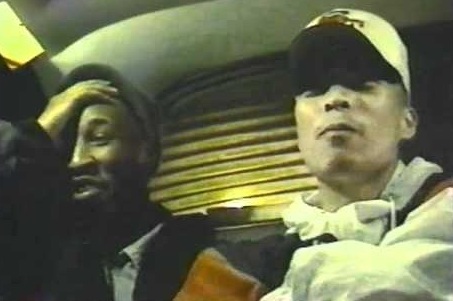
Roc Raida & Q-Bert in Battle Sounds (1995)

5. Outside of a movie like Juice or Wild Style, would you consider Battle Sounds to be the first true link between strictly turntablism and cinema?

JC: I'd have to say yes. The term was created at the same time as the production of the film in 95. You got to check out my latest turntablist project at http://blog.dubspot.com/stylus/


BONUS QUESTION: What is your favorite film about or based in Brooklyn?

JC: Dog Day Afternoon, Do The Right Thing, Saturday Night Fever.

WHAT HAPPENED TO WENDELL B. HARRIS JR?

'Chameleon Street'
I know I'm not the first person to bring this up but...How do you go from being a grand jury prize winner at Sundance (during a time when that actually meant something) among a talent pool of directors like; The Coen brothers, Spike Lee, Hal Hartley and Todd Haynes to essentially becoming just a cult figure among snooty Black American film snobs and Steven Soderbergh (probably the only prominent figure in Hollywood that has kept Harris' name relevant)? People make all this fuss about the return of hermit filmmakers like Terrence Malick and Monte Hellman but at least they have more than a few films to show for. All Wendell B. Harris has to show for in 22 years is Chameleon Street (an important film in many circles ranging from hip-hop culture to the cult film world). Sure he's got that cameo in Soderbergh's Out Of Sight as well as in Roadtrip (...???), but as a director he's only got that one movie (which is a classic if I might add). Of all the filmmakers to emerge out of that indie/Sundance scene in late 80's/early 90's, how is it that someone like Wendell B. Harris gets left behind? And I don’t mean to insult the man by using the term "left behind", but...it’s true. And it’s not his fault. How is it that during the mini-explosion of black filmmakers and films in the late 80's/early 90's that Wendell B. Harris was essentially “left out” and not included (similar to Charles Burnett). When you look at that famous New York Times Cover from 1991 on the New Black Cinema movement you notice Harris (and Burnett) are left out. I don’t get it. Not to sound like a child trying to start beef but in my opinion Harris and Burnett are much better filmmakers than more than half the people in the photo below (no offense but its true). I know Black directors like Harris and Charles Burnett have gained notoriety in places like Europe (which is great) but on a certain level their films weren’t really made for them (not to say Europeans can’t enjoy and/or love Chameleon Street, Killer Of Sheep, The Glass Shield, etc), but Americans (especially Black Americans) should be the real demographic to embrace these kinds of films.

Top Row (left to right) - The Hudlin Brothers (House Party), Ernest Dickerson (Juice), Mario Van Peeples (New Jack City), Mid Row (left to right) - Spike Lee (Jungle Fever), Matty Rich (Straight Outta Brooklyn), John Singleton (Boyz N The Hood), Bottom - Charles Lane (True Identity)

Had Hollywood/American Independent cinema reached its quota of Black directors? Was one or two more too much? Here’s something else that strikes me as odd: Similar to film movements like The French New Wave, New German Cinema and even Dogma, the Black American director explosion was about collaboration and/or helping each other out. Melvin Van Peeples (who still continues to direct) essentially passed the torch on to his son, Spike Lee put out Drop Squad and other films made by Black directors through his 40 acres & a mule production company, Ernest Dickerson moved on from being Spike Lee's cinematographer to becoming a director himself and actors like Samuel L. Jackson, Bernie Cassie and Sy Richardson made it a point to act in as many movies directed by Black directors as possible. Where was Wendell B Harris' support from the Black film community when he needed it? Hey, maybe hands were extended out to him and he didn’t want the help. I don’t know, Im just asking. Let’s face it…in the realm of "Black cinema" (a label I sometimes embrace and sometimes hate) Spike Lee was essentially the poster child. His films were popular, almost all of them were great (with a few exceptions like Girl 6) and so many filmmakers and films branched out from him. I’m not even basing this off opinion. That’s just how it was. And even when a Black director put out a film that had absolutely nothing to do with him he found a way to tie himself to it by starting some kind of “beef” (like he did with Matty Rich & Straight Outta Brooklyn). I wonder if Wendell B. Harris had to go through the B.S. of movie studios wanting his films to be more like Spike Lee after Chameleon Street was released (just like in Hollywood Shuffle how casting directors wanted all the Black actors to be more like Eddie Murphy). Maybe the powers that be in movieland didn’t realize that it was ok to have more than two or three prominent Black voices in cinema. Sure, Chameleon Street is somewhat of an obscure/cult hit TODAY, but what about 20+ years ago? These days Wendell B. Harris is working on an on-going fiction/documentary hybrid about Roswell and Aliens which may never get finished (he's been working on it for YEARS). But I'm gonna be honest (and I think many of you aware of Harris’ talent can feel me on this) I'm not interested in a documentary about Roswell from someone like Harris who must have a lot more to say in terms of race, racial identity, society, etc. Just sayin'. Between Obama and the current state of Black music to Oscar Grant & Trayvon Martin, we need Harris' voice more than ever. Judging from Chameleon Street and various interviews, Wendell B. Harris strikes me as a progressive thinking, rule breaking and hardheaded figure that would possibly clash with producers or studios. The film he planned to do after Chameleon Street was supposedly an off-the wall re-telling of Grease so I can imagine how that went over when trying to pitch it or getting funding. But even the hardest headed of maverick, rule breaking directors have gone on to make a name for themselves or have at least been given a few opportunities (Alex Cox, Donald Cammell, Lars Von Trier, Melvin Van Peeples, etc). Kinda like what I said in my write-up on Chameleon Street last year: If movie studios all over the world have tossed money at someone like Alex Cox, why not Wendell B. Harris? What was it about Harris that made studios and/or producers stay away and not wanna work with him? It looks like he’s the true S.D. Sallinger of filmmakers. This is something that really needs to be looked in to.


Wednesday, June 20, 2012

STORYTELLING: TODD SOLONDZ' MISUNDERSTOOD MASTERPIECE

"Fiction"                                                                                         "Non-Fiction'
In the late 90's Todd Solondz managed to become one of the most influential yet underrated American filmmakers of his time. He got worldwide acclaim and pretty much fathered the Sundance scene of the late 90's and early part of the last decade, yet he still stayed under the radar in comparison to his other contemporary American indie director peers like Tarantino, Kevin Smith and even Todd Haynes. After the success of Welcome To The Dollhouse and the controversy & hype surrounding the content & dark humor in Happiness his way was paved for success in the next decade. But one problem after another plagued his career and made this past decade a bumpy one for him all starting with Storytelling. But people get so caught up in the controversy around Storytelling (the fact that it was unfinished and Solondz apparently had a big falling out with Christine Vachon) that they forget it’s a great a movie (unfinished or not). Todd Solondz isn’t the first American filmmaker to emerge from the Sundance scene that was given a "major indie deal" only to run in to problems. If you read any material on American indie film from the late 90's you'll see that Todd Solondz, Todd Haynes and Hal Hartley are almost always mentioned in the same breath just as David Lynch and David Cronenberg are commonly associated with one another. From the late 90's leading in to the early part of the last decade all three of their careers kinda ran parallel with each other. In 1998 all three directors saw success with their films; Happiness (Solondz), Velvet Goldmine (Haynes) & Henry Fool (Hartley), were given bigger movie deals and strangely enough, all three directors released their next films around the same time yet again (between 2001 & 2002). Things seemed to work out fine for Haynes with 2002's Far From Heaven which got numerous academy award nominations and was probably Dennis Quaid's greatest (and most unexpected) performance to date. But Hartley & Solondz didn’t have the same "success" that Haynes had. After the surprise popularity of Henry Fool, Hartley's next feature length film (No Such Thing) was produced by American Zoetrope studios (George Lucas & Francis Ford Coppola) in 2001 and for the first time Hartley was working with a cast of actors like Julie Christie and Helen Mirren yet the movie, which is underrated in my opinion, "flopped". After Happiness, which was a minor crossover hit (being nominated for a golden globe and best picture at Cannes), Solondz got the attention of New Line Cinema and in 2001 he found himself working with his most diverse cast to date: John Goodman, James Van der Beek, Franka Potente, a pre-sideways Paul Giamati and even a cameo from Conan O’Brien! But Storytelling ran in trouble before it hit even hit the festival circuit. Solondz had censorship problems because of a sex scene about racial taboos involving Selma Blair where she was ordered to scream: "Nigger, fuck me" over and over again by The Wire's Robert Wisdom. Solondz was forced to cut the scene so he wouldn’t get an NC-17 rating (which is pretty much the “kiss of death” for a movie), but instead out of protest he placed a giant red box over the actors, which many people thought was silly and childish but I actually thought it was pretty funny...


And speaking of cut scenes, Storytelling took another major blow on the cutting room floor. The third act from Storytelling, which involves some kind of a graphic sex scene between a closet homosexual football player (played by James Van Der Beek), is one of the last films in an infamous group of rare & unfinished movies like Terrence Malick's Lanton Mills, Werner Herzog's A Game In The Sand' and Quentin Tarantino's My Best Friends Birthday that we'll probably never get to see. For reasons that still remain unknown 11 years after the film’s release, the third part was cut from Storytelling making it an incomplete film. Some speculate that because Van Der Beek's character in Storytelling was a high school football player that it conflicted with Varsity Blues (which was released a year earlier) and some mysterious studio powers that be had his part cut from the film. Or did it have anything to do with Van Der Beek being on Dawson’s Creek and a gay character wouldn’t sit well with the family friendly fan base? I don’t know if I buy either of those reasons because during the time Van Der Beek was on Dawson’s Creek he starred in Rules Of Attraction which featured just as much vulgarity and sex as Storytelling. He also made an appearance in Jay & Silent Bob Strike Back which had an average one gay joke every 2-1/2 minutes so it couldn’t have been that either. To this day I find myself googling around trying to find that one interview or write-up that clearly explains what the problem was involving the third story from Storytelling but I have yet to find it. But this major cut in the film still didn’t stop the promotion (actually by the time it hit theaters a lot of people didn’t even know that a big part of the film was missing). Todd Solondz gave the pedophilia a rest this time around and addressed issues like racism, white guilt, the America family and he even addressed his nay saying critics in a not-so subtle way. Solondz still focused a good portion of the film on youth which is common in just about anything he does. The film is made up of two unconnected stories ("Fiction" & "Non-Fiction") that both take place in New Jersey...

"FICTION"
The first story centers on "Vi" (Selma Blair); An untalented journalism major with dreams of being a writer. In the middle of the story she's faced with whether or not she should sleep with her black professor who clearly has a "thing" for young white women. Fiction not only deals with the so-called taboos of interracial curiosity and racial fetishism but it’s also a comment on the taboos of sexual relationships between college professors and their students (sure, both sides are adults but there's an ethical factor to consider). Fiction was also made to address Solondz' critics who found his previous work disturbing and gross.

"NON-FICTION"
Non Fiction - The second story is about a documentary filmmaker (Paul Giamati) and his attempt to make a film about an everyday American teenager (Steven Weber) and his family. But a series of surreal and unexpected events occur that affect the production (hypnotism, paralysis and murder). Non-Fiction features a surprise cameo from Conan O’Brien and is one of John Goodman's last memorable performances. 

It’s commonly agreed among most Todd Solondz fans that Happiness and Welcome To The Dollhouse are his definitive films. In my opinion Storytelling should be added to that group of "definitive Solondz films". But because it’s been clouded with Terry Gilliam-like post production problems and faced some HEAVY editing, most people have forgotten about it. Storytelling stands as an important film in Solondz' career. It showed growth and his ability to tackle new subject matter just when people were starting to pigeonhole him all while still maintaining his unique darkly quirky sense of humor and that key dream sequence that comes with every one of his films. In the same way Solondz had us laughing at the absurdity of 11 & 12 year olds calling each other faggots in Welcome To The Dollhouse or depression and perversion in Happiness, Solondz had us laughing at everything from racism to a family being set on fire in their sleep in Storytelling. Sorry, but it’s just as much a Todd Solondz film as Happiness is. Just as the ensemble character/crisscrossing plot movies were starting to die down in the late 90's, Michael Haneke (Code Unknown), Steven Soderbergh (Traffic), Guy Richie (Snatch) and Alejandro Inarritu (Amorres Perros) breathed new life in to the genre at the start of the new decade. When connecting the stories seemed like the "in" thing to do, Solondz went the route of his peer Todd Haynes (Poison) and separated the stories. Was he intentionally trying to make some kind of a statement against those kinds of movies? Of course not. His last movie prior to this was Happiness (one of the more popular ensemble films of the late 90's). But weather he meant to go against the grain or not, Storytelling was still a breath of fresh air.


Friday, June 15, 2012

BAD LIEUTENANT: PORT OF CALL NEW ORLEANS (WERNER HERZOG'S MISUNDERSTOOD MASTERPIECE)

Shoot him again...his soul is still dancing - Nicholas Cage

By now you should all get the general idea of what a "Misunderstood Masterpiece" is by the movies I've covered so far. They're movies with ridiculous sounding plots like; Trouble Everyday (a horror/drama/psychological thriller about an unnamed disease that gives people killer libidos) & Demonlover (an erotic espionage thriller about the deadly, backstabbing underworld of animated pornography), or remakes/loose adaptations of classic films like Solaris and Ghost Dog (a loose remake of Le Samourai) that all received undeserved amounts of hate upon their initial release but are slowly starting to get the recognition they deserve for being strangely brilliant. These are the kinda films that follow in the footsteps of Maverick filmmakers like Donald Cammell and Nicolas Roeg. The kinda of movies where some type of a drug (strong marijuana at the very least) played a role in the development of the script or at least the basic concept. The kinda movies where you have to say; "ACTUALLY, I liked that movie a lot." Those movies that get 20% ratings on Rotten Tomatoes and bad reviews, but 10-20 years later they're in some kind of a retrospective at the Moma, Lincoln Center or Film Forum.
I can’t think of any other recent film that fits the above criteria more than Werner Herzog's Bad Lieutenant: Port Of Call New Orleans...


Werner Herzog's Bad Lieutenant: Port Of Call New Orleans (a loose remake of Abel Ferrara's 1992 indie masterpiece) has become that movie where people have to start defending it before they even finish saying how much they liked it. It’s that movie where you have to start talking about it with a preface like; "I know you're not gonna believe me when I say I like this, but just hear me out..." What’s also interesting is that in the last decade or so Bad Lieutenant has been one of the FEW great (yes, great) films that Herzog has put out along with The Wild Blue Yonder and Grizzly Man. Rescue Dawn teetered between being bad and pointless (I don’t care how dedicated or how much weight Christian Bale lost for his role), Into The Abyss was a disappointing and almost disrespectful documentary that showed Herzog acting all buddy-buddy with sociopathic murderers and not even Michael Shannon's presence could save My Son, My Son What Have Ye Done (probably one of Herzog's worst films ever, which is sad because it had an amazing ensemble cast). It goes without saying that Nicolas Cage and remakes aren’t a good combination. And I'm not just saying this because making fun of Cage's recent cocaine & pills-fueled performances have become the "in" thing to do these days. I'm actually a fan of Nicolas Cage from time to time when he delivers performances like he did in Adaptation, Red Rock West or Wild At Heart. But with remakes like City Of Angels (a remake of Wim Wenders' Wings Of Desire), The Wicker Man (a remake of the cult classic), Kiss Of Death and Bangkok Dangerous (a remake of a famous Thai action film), history has clearly shown that Cage is poison to a remake. Just doing a remake alone is an uphill battle from the start since 10 time outta 10 you're gonna get naysayers and diehard fans of the original hating on it before it even comes out. I went in to Bad Lieutenant expecting to see an epic disaster so bad that it would be entertaining but to my surprise it turned out to be one of my favorites of 2009. And I knew I wasn’t crazy because by the end of the year I saw Bad Lieutenant on the top 10 & 20 lists of everyone from Roger Ebert to various writers & contributors to magazines like Film Comment and Cahier Du Cinema (I know that just because some highly decorated film critics like something doesn’t automatically make a movie great, but it still means something). Most people who end up seeing Herzog's remake are usually in disbelief at how good it was and the few people that hated it still end up talking about it. Next to Bad Lieutenant I can’t think of too many other films in the last 5 years that have gotten me into heated debates/arguments/conversations about everything from the current state of cinema to racism and police brutality.


Werner Herzog doesn’t strike me as someone who needs to take drugs to make something that’s strange and far out. He's just a naturally unique and quietly quirky human being where "strange" just comes naturally to him. But I’m sorry, he must have taken some peyote or mysterious herbal drug while coming up with the idea to remake Bad Lieutenant, which he claims he never actually saw (sounds like bullshit to me, but whatever). And the more I think about it no other actor could portray the role Nicolas Cage played because when you think about it, his real life kinda runs parallel to the character he plays in Bad Lieutenant. In the film detective Terrence Mcdonagh was a once promising police officer but years of drug abuse, gambling, corruption and a crippling back injury are catching up to him while he's working on a gruesome murder case (an immigrant family has been murdered by a local drug kingpin). In real life, Nicolas Cage was an A-list actor (I guess he still kinda is) but years of bad movie choices and bankruptcy have forced him to act in just about any movie that comes his way so he can make money to get himself outta debt. The basic plot of Herzog's Bad Lieutenant is pretty similar to the original: both films are about a corrupt, out of control, drug & gambling addicted police officer who's life is spiraling out of control. But at the same time Herzog takes a few liberties and changes some stuff around. In this version our main character has a partner (Val Kilmer), its set in New Orleans during the aftermath of Katrina (the original is set in New York City), there’s no outright religious symbolism (a staple in Ferrara’s work) and we get more of a glimpse in to the main characters' love life (Eva Mendes). And even though Keitel’s performance is WAY better than Cage's, Cage seems more likeable (even when he points a gun at the head of an old lady). Throughout the film Cage's character is suffering from a permanent back injury and he does an amazing job at making it believable. You grunt and squint along with Cage as he hobbles through the film or strains to stand up. He's the kinda antihero you don’t actually want to be or emulate. You just wanna watch him from a distance. He's like a fascinating train wreck. And no matter how corrupt and fucked up Cage is at no point in the film did I laugh WITH him or think he was cool. Throughout the entire film I’m laughing at him as Bad Lieutenant is essentially about someone who thinks their above the law but in reality they're on a downward destructive path that’s so unbelievable all you can do is laugh in disbelief as we watch him accidentally snort heroine instead of cocaine just before he has to go to work, steal police evidence, blackmail college athletes to throw games he's betting on or wear his gun inside his belt instead of a holster because he thinks he's some kind of a cowboy. Bad Lieutenant is pure insanity. Herzog once again captures the egomaniac, alpha white male who goes too far when trying to abuse power reminiscent of so many roles that Klaus Kinski played under his direction (Cobra Verde, Fitzcaraldo and Aguirre: The Wrath of God). Herzog even puts a little of himself into Cage’s character. Some of the lines in the film like “Do fish have dreams?” and “his soul is still dancing” are quotes and questions from the book “Herzog on Herzog”.


Bad Lieutenant has what seems like intentionally over the top moments that kinda come out of a comic book (the dramatic music, the reactions of some of the actors to certain situations and pretty much the last ten minutes). On the surface this seemed like an odd choice for Herzog that doesn’t really fit in with the rest of his filmography. As far as the cinematography goes this may be his most polished-looking work to date. In fact, after the release of Bad Lieutenant there was a great book of stills taken by Herzog's wife that got published. But at the same time there's many Herzog-like elements to Bad Lieutenant outside of Cage's insane Kinski-inspired lead performance like randomly beautiful scenes involving iguanas and crocodiles (as we all know Herzog loves animals and nature), odd musical choices reminiscent of the dancing chicken scene from Stroszek and Herzog's fascination with people from the continent of Africa. Bad Lieutenant also features an eclectic supporting cast of actors like Brad Douriff, Michael Shannon, actor/director Vondie Curtis Hall, Xzibit, Faruza Baulk and Shea Whingham who has probably my favorite scene in the movie (see below). Don’t judge this until you've actually seen it because chance are you'll be pleasantly surprised.

Friday, June 8, 2012

KIDNEYS ON FILM PART THREE: KIDNEYS ON A PLANE (AIRPORT 1975 & AIRPLANE!)

Airplane!                                                                                  Airport 1975
So far we’ve covered everything from Julia Roberts’ unrealistic portrayal of kidney failure in Steel Magnolias to David Cronenberg’s cutting edge use of parasites to replace human organs in Shivers. Now I’d like to address something that’s been kinda bugging me since my transplant four years ago…

Airport 1975 and its parody; Airplane! had something that many disaster films don’t have today: characters in the midst of a crisis that are dependent on some form of medication or a machine to live. We don't see that too often in disaster films these days. And this isn’t just a problem with today's disaster movie genre either. In today's thrillers & horror movies where we see characters trapped somewhere and can’t go out or make a sound because they'll be eaten by zombies (Dawn Of The Dead, The Descent, Rec, etc), killed by vampire-like mutants (I Am Legend) or trapped on an elevator (Devil), we rarely seem to have a character in need of liver meds, hearts meds or...kidney meds. The only recent film to even kinda touch on this was Con-Air when Nicholas Cage’s friend needed insulin on the hijacked plane but they couldn’t get to it. On television there was an early episode of Lost where one of the people stranded on the island needed an inhaler or she'd die from an asthma attack. But that’s about it. Sure more television shows have been focusing on kidney transplantation (Curb Your Enthusiasm, Family Guy, American Dad), but never under the extreme circumstances that I’m talking about. Is Hollywood blind? Adding this kinda element to a thriller or horror movie would work on two levels. It would add realism to an otherwise unrealistic plot. I mean let’s face it; in this day & age there seem to be more & more legitimately medication-dependent people in this world due to organ transplants than ever. Let’s say in 2012 that zombies really do attack and a group of people are stuck together in a shopping mall or an abandoned house to hide from the brain eating monsters and can’t go outside. The odds of someone running out of or needing medication at some point in the near future is highly likely. This would also add excitement to the story. Another monkey wrench thrown in to the spokes. Speaking from personal experience, the most kidney meds I keep on me on a regular day is two days worth. And for those of you asking why only two days worth; it’s because there aren’t any pill cases compact enough to hold the 24 pill a day supply I need without being a fucking nuisance in my pockets. If that zombie attack hit RIGHT NOW, in 36 hours I'd be pretty screwed (although I could be as healthy as a horse and I'd probably still die due to the fact that I'd be a black person in a zombie scenario. History has only proven that we don’t last in these movies). But think about it for a second - if there was a character in need of meds in a short period of time or they're organ would fail ultimately killing them, this adds a new mission to the story. A group of people would have to venture out among the zombies, mutants, whatever to make it to the closest pharmacy (where the zombies would obviously be waiting) to get the medication for the dying organ recipient before it’s too late. And this wouldn’t be a quick task because they’d have to fight their way behind the counter then proceed to read the labels on the bottles to make sure they got the right meds (it would certainly suck if they did all that work only to bring back cold sore medication to a kidney transplant recipient). It would be a nail biter, wouldn’t it? And naturally everyone wouldn’t make it back (probably the sacrificial token black guy).


Both Airport 1975 and Airplane! involve the same commonly forgotten subplot where a little girl is in need of a kidney transplant but the plane taking them to their future life saving organ malfunctions and someone has to land the plane before it’s too late (obviously if no one can land the plane then everyone will die, making the transplant irrelevant but whatever). They weren't just the "sick girls" that they're commonly labeled as. They had a specific illness and that illness was kidney disease (had they needed a heart transplant or had sickle cell you'da remembered). But between the two movies, people were too distracted by pedophile jokes, Charlton Heston's rugged manliness, jive talk and Leslie Nielsen's brilliant deadpan performance to remember. Even though these movies were made in the mid-70's the subject matter is more relevant today. Due to mass kidney swaps these days which sometimes involve up to 20+ people all over the country, planes are required to take ‘em from one end of the country to the next for a transplant. I guess Airport 1975 and Airplane! were just ahead of their time...

Monday, June 4, 2012

SILENT LIGHT: BORING MASTERPIECE #6

Working with non-professional actors can be a gamble at times because, well...they can’t always act and don’t always posses the skills to convey different emotions or transform in to the character that the story requires. Sure there's exceptions and there are directors out there who have the power to create a world where not being able to traditionally act can work (like the deadpan/almost emotionless world of Robert Bresson) but for the most part it’s a role of the dice. Non-professional teenage actors have been the safest bet in recent years with films like; George Washington, Fish Tank (the lead actress only), Elephant (although it did feature Matt Malloy & Sam Bottoms) and Paranoid Park because these films pretty much just require our lead teenage actors to essentially be themselves (this doesn’t mean that these movies aren’t great, btw). But I can’t think of too many films with non-professional adult actors that have really worked in the last decade outside of a few exceptions. One of those exceptions would have to be the Tarkovsky-influenced work of Carlos Reygadas who somehow managed to get everyday people who have never stepped in front of a camera to cry, murder and have real sex in his first two films (Japon & Battle In Heaven). With his third film; 'Silent Light', he took the use of non-professional actors to another level by using a demographic of people who you'd least expect (Mennonites) and made a film about love, adultery, spirituality and self reflection. Let’s be honest...adultery, spirituality, love, etc aren’t exactly the kinda things that pop in your head when you think of Mennonites. On television and in film they're painted as emotionless people who do nothing but work and fear god. But Carlos Reygadas tried to dispel that myth with Silent Light: the story about a family man ("Johan") who's torn between his wife; "Marianne" and the woman he's been having an affair with ("Esther"). I know the idea of cheating Mennonites may have you scratching your head, but at the same time...why not? We've already seen plenty of films about adultery where the husband who's too busy with work or having an affair with another woman pushes his wife away forcing her to be with another man, or the other scenario where we see the mean, bitchy wife who doesn’t appreciate her husband causing him to look for love somewhere else. Why not put a new spin on the genre by incorporating non-professional actors, religion, faith, spirituality and a BLATANT sympathetic look at the adulterers (which may not sit well with people who have been cheated on in the past).

One noticeable thing that Carlos Reygadas did this time around was draw influence from a director outside of just Andrei Tarkovsky. Don’t get me wrong, the slow, numbing pace and atmosphere of Silent Light is the same as Japon and Battle In Heaven and it has its share of Tarkovsky influenced moments... 
'Nostalghia' - Tarkovsky                     'Silent Light'-Reygadas
but its biggest influence would have to be Carl Theodore Dreyer's Ordet (specifically the funeral scene at the end)...
'Ordet' - Dreyer                              'Silent Light' - Reygadas
Silent Light also bears a striking resemblance to Chantal Ackerman's work in both pacing and imagery. The scene in the beginning where Johan sits at the dinner table and breaks down is right outta the beginning and opening scene of Ackerman's Jeanne Deilman...
'Jeanne Dielman' - Ackerman                      'Silent Light' - Reygadas

Neither Johan or Esther are made out to be bad. They come off as two people who can’t fight their love for each other even if it means destroying Johan's family. Johan and Marianne are probably two of the most complicated & complex characters Carlos Reygadas has ever come up with. There are plenty of films out there where a religious figure (usually some sexually repressed priest) has the hots for some pretty young thing, but it’s also presented as a sin and those characters look to god for help to make these urges go away. But In Silent Light, Johan not only looks to god, but he also goes to his religious father for advice about what woman he should be with. And to Johan's surprise the advice he gets is somewhat unexpected. Although I obviously recognize that what Johan is doing to his wife is dead wrong, I never find myself going; "oh this guy is a scumbag!" like I would do to other cheating male characters. I feel like I should, but I can never bring myself to think that about him like that. There's even a scene where Johan has the nerve to try and get Marianne to look at Esther's point of view about all of this (pretty ballsy for a man to try and get his wife to see things from the perspective of the woman who’s cheating with her husband). And this has nothing to do with me being a man and automatically wanting to sympathize with the male lead. Through the actor’s performance I genuinely believe he's a man who can’t fight love. Marianne's approach to this ordeal is a strange combination of passive aggressive, compliant, hurt with a touch of taking the high road. From the start of the film she's well aware that her husband has been unfaithful to her but her stance in the matter is being quiet and letting him decide who he wants to be with. It’s the kind of performance that will have people debating and arguing forever. Is she just another weak housewife character that essentially allows her husband to be with another woman or is her character a strong saint of a woman who's being the "bigger person" in all of this? That remains to be seen by the end of the film. Johan & Marianne's children are also an interesting element to the story because these naive, cute, innocent-looking children whose presence is felt all throughout the film has no idea of the intense drama that’s going on between their parents (the opening scene where the family has breakfast together highlights this). A lot of the hype around Silent Light came from Martin Scorsese’s praise of the film. Say what you will about Marty as a director these days but his love for (good) cinema hasn’t seem to have left him. Normally I'm not a fan of big name directors like Scorsese giving a co-sign to a smaller, art house film that they had nothing to do with because they're name becomes more synonymous with the film than the person actually responsible for it (similar to how Quentin Tarantino always seems to co-sign a film that has Asian people in it). But that didn’t happen with Scorsese and Carlos Reygadas. What it did do was give this film, which is easily one of the best films of the last decade, the push that it needed because otherwise it may have fallen in to that film festival circuit/one week run at a local art house cinema category.


Friday, June 1, 2012

"BUMPING INTO WALLS": ARCHITECTURE & DESIGN IN THE TREE OF LIFE

I just feel like I'm...bumping into walls - Sean Penn (The Tree Of Life)

Usually when someone sees a scene in a movie that KINDA reminds them of something in their own personal life they go: "oh man, that is SO my life" or "that's totally me." But 9 times outta 10 they're overdoing it and just wanna relate to something in a movie so that they can feel cool. Even as much as I love movies VERY RARELY do I see a scene that reminds me of something in my own life. Last time I checked they haven't made any biopics on left handed, diabetic, djing, autocad drafting, kidney transplant recipients with odd mannerisms and an unhealthy fascination for cinema. Even the scene of discussion doesn't even fully relate to me. For those of you who haven't seen The Tree Of Life or this specific scene in particular, a lot of Sean Penn's angst has to do with the loss of his brother which still haunts him (I imagine this scene probably works on an even deeper level for Penn as he lost his brother in real life not too long ago). I'm an only child so I don't know anything about the loss of a sibling and would never try to relate anything in my life to something like that. But what does standout to me is the setting (some kind of an architectural or design firm) along with Sean Penn's aimless/disoriented wandering through his office full of marked up & redlined drawings that look like they're in their 80th revision and probably have 80 more future revisions to go before the job even goes in to production. For those of you who don't know me well, I'm not crazy about my career and often find myself questioning why I do what I do. I spend the majority of my work day thinking about movies or music while my desk is covered under highlighters, bad sketches and floor plans. I think a big part of the reason as to why I've stayed in my field for so long is because I went through one of the toughest undergrad programs (architecture) and cant just give up after all the work I did for five years.

It’s kinda difficult to make out what Sean Penn is saying in this scene (and throughout most of the movie in general) because all he does is mumble. But the one line that does stick out at around 2:52 is: "I just feel like I'm bumping into walls". Naturally this is a line that just about any human being can relate too, but in the world of design I don’t know if there's a better tagline. When you graduate from school with a design-oriented degree you seriously think that at age 22 or 23 you're gonna be designing skyscrapers and have articles written about you in Architectural Digest. But in reality you're measuring staircases, making sure the hallway or corridor you design is wheelchair accessible, renovating kitchens or trying not to get thrown under the bus by one of your co-workers. And even if you are lucky enough to be part of a team that does design a building you can’t really do what you want because of all the codes you have to follow. I don’t know about you guys but that sounds like "bumping in to walls" to me. This scene also brings up envy (lol) - even though I'm not crazy about design or what I'd do, I would kill to work in an office like Sean Penn's office in The Tree Of Life. The imagery in this scene has some of the best looking architectural shots since Lodge Kerrigan's last two films...

These are all the thoughts and feelings that this particular scene brings up inside of me. Its that subconscious link between cinema and architecture (two things that encompass a big part of my life) that few filmmakers have been able to show. When I watch this scene I'm reminded of the time when in a few short months I crossed paths with three completely different filmmakers (Karim Ainouz, John Carluccio and Apichatpong Weerasethakul) who all studied architecture in school but moved on to film instead. Was this just a coincidence? Was some spiritual being or higher power trying to tell me something about what I should really be doing with my life? What is it that makes architecture & design suck so much that turns people towards film? In a way this is partially what The Tree Of Life is about - Random thoughts, questions and the subconscious. And in my opinion this scene highlights that and its proof that the movie is a success.

Architecture/Design/Space Planning/Urban Planning/etc can be a pretty stressful field. You're either always stressed out about the insane amount of work you have on your plate combined with the ridiculous deadline you have to complete it by. Or...you're stressed out about the LACK of work you have sitting at your desk for 9 hours with nothing to do. And when you’re jaded & cynical it’s even worse because you have to force yourself to care about something you couldn’t give two shits about. I know this applies to many jobs out there but in the world of design it’s dangerous because there's a lot of money at stake (money you won’t be seeing any time soon) and its easier for mistakes to be made. What’s also frustrating is the misconception most people have about the world of architecture and design. I can’t tell you how many times I've grit my teeth or clinched my fist inside my pocket after hearing someone say; "oh you must be making the big bucks, huh?" I know they mean well but at the same time I just wanna casually say; "shut the fuck up."
Terrence Malick strikes me as someone who's never stepped foot inside of an architecture studio or design firm as he comes off like someone who'd be more at home in a field of weeds chasing butterflies. Yet he somehow "gets it" in this scene. I think many of us in this field have had the very same "what am I doing?" or "what does it all mean?" phone conversation (usually with a peer or someone we went to school with) that Sean Penn is having in this scene. I'd love for these moments in the video below to be turned in to a feature film. I know this won’t be happening any time soon because Terrence is currently working on two new films at the same time (and editing a third film). But maybe this blog entry will cause some kind of a cosmic butterfly effect that gets him to make his next film about Architecture (although that probably won’t happen). But until that cosmic moment happens we still have Peter Greenway's Belly Of An Architect (a possible blog entry for July)...


100 GREAT CINEMATIC DEATHS (THE PINK SMOKE)

More awesomeness from the pink smoke...

100 GREAT CINEMATIC DEATHS

Wednesday, May 23, 2012

50 FAVORITE FILMS OF THE 90'S: PART ONE (THE PINK SMOKE)

The votes are in. The movies are in order. We have spoken. Here's the first part of the pink smoke's favorote films of the 90's...
#41-50

Tuesday, May 22, 2012

MOONRISE KINGDOM! (MUSEUM OF THE MOVING IMAGE EXCLUSIVE)

Who needs to go all the way to France to see Wes Anderson's new movie before it hit theaters when you can just get on the N train and go to Astoria?! Thanks to the Museum of the Moving Image I got a sneak peek at one of the most buzzworthy films to come out of the Cannes film festival so far. Before we go any further with this review I'll just get it outta the way and say that Wes Anderson's latest film is very good and worthy of all the early praise it’s been getting. It's a pretty typical thing to say in a movie review but this may be one of his best movies and we see a side of him as a director we haven't seen yet (Moonrise Kingdom has more special effects than any other Wes Anderson movie with more than one daring rescue attempt). Drawing inspiration from the beginning of Royal Tenenbaums where we see young Richie & Margot run away from home together, Moonrise Kingdom is also about two children in love who do the same (and the search party that's out to find them and bring 'em home). Our two main characters are "Sam" - a troubled orphan boy scout with no friends who's foster family doesn't want back, and "Suzy" - the daughter of two lawyers that barely speak to each other (and she kinda has a bit of a temper). The only problem with Sam & Suzy's plan to run away is that they can't get very far due to the fact that they live on a secluded New England island thats about to face it's biggest rain storm in history.
I was worried that The Fantastic Mr. Fox would be a fluke and Anderson would go back to his regular quirky B.S. that some of us have grown a little tired of. But this time around he doesn’t force his meticulously quirky 1960's "look" on a story that takes place in 2012 (we get it Wes, you like nostalgia, artifacts from back in the day, corduroy and British pop music, but after a while the world of Wes Anderson can start to get a little played out). Instead he finally just sets the story in the 1960's making his signature look, soundtrack and overall vibe of the film seem less forced. He gives his India fetish a rest, there’s no sign of a Wilson brother and along with his regular cast of actors like Bill Murray (Suzy's father) & Jason Schwartzman (a rival scout leader who helps Sam and Suzy escape on their second attempt), Anderson makes room for new faces like; Bruce Willis (the town sheriff in charge of finding Sam & Suzy), Ed Norton (Sam's scout leader), Frances Mccdormand (Suzy's cheating mother who communicates with her children through a megaphone), Tilda Swinton (a social worker, and the only character in the film that doesn't have an actual name) and Harvey Keitel (who's appearance is short but since he's my favorite actor and hasn’t been in anything good in quite some time, I'll take what I can get). Highlights from Moonrise Kingdom include Jason Schwartzman’s quick performance, Bob Balaban's narration and just overall presence (seriously, how has he never worked with Wes Anderson until now?), a boy scout getting stabbed in his kidney with scissors, Ed Norton rescuing Harvey Keitel, one of the main characters getting zapped by lightning, all the tracking shots, a funny Shawshank Redemption reference and pretty much the last 15-20 minutes of the movie. Animal lovers should be warned that there is a heartbreaking scene involoving the death of an animal. I also love Anderson's decision to cast two young unknowns as the main characters surrounded by a supporting cast of A-list veterans.
 Ever since the disappointing Darjeeling Limited and Life Aquatic (a film some people found to be a lil' problematic once the hype around it settled down), it seems like Anderson gave the quirky rich/upper-class family dramedy genre a rest and has been focusing more on making family oriented films. Naturally this will be loved & praised by the hardcore Wes Anderson fans that’re still in denial about how bad Darjeeling Limited really was, but it’s also a great movie for restoring faith in people that once loved Wes Anderson but have started to get a little sick of him.

Monday, May 21, 2012

CONTAGION: COVER YOUR F*CKING MOUTH!

Once again I apologize to my loyal PINNLAND EMPIRE followers as I haven’t been updating as much as I usually do but The Pink Smoke is working on some pretty awesome projects that they’ve asked me to contribute to and I couldn’t say no. BUT…I finally got around to watching ‘Contagion’ on Sunday and was so genuinely surprised at how good it was that I made time to write about it. Of all the 2011 films that I finally got around to watching this year (‘Super 8’, ‘Beginners’, ‘A Separation’, etc), this is the one film that stuck out the most so far. Is ‘Contagion’ one of Steven Soderbergh’s best films? Of course not. But did it deserve to be written off as fast as it was (especially when it did get fairly good reviews and holds a solid 83% on rotten tomatoes)? No. I was one of those people who dismissed ‘Contagion’ upon its theatrical release but now I’m kicking myself because it woulda been a pretty entertaining experience in the theater. No matter how close minded I am at first I always get around to watching (and sometimes buying) every Soderbergh movie. From ‘Ocean’s 13’ to ‘Full Frontal’, I end up watching ‘em all. Hell, his adaptation of ‘Solaris’ ended up becoming one of my all time favorite movies. I can’t exactly put my finger on why, but I honestly think he’s a genius and extremely talented beyond his ability to churn out movies like its nothing or to seamlessly jump from one genre to the next. Even with some of his mediocre work that leaves you shrugging your shoulders like; “…ok”, I still think there’s something in many of his movies that we aren’t seeing. ‘Contagion’ has the visual style of ‘Bubble’ and ‘The Informant’ (colder, steady and longer shots with strong bold and almost unnatural looking colors) along with an ensemble cast that rivals a movie like ‘Traffic’ (Jude Law, Matt Damon, Laurence Fishburne, Kate Winslet, Marion Cotillard and Gwyneth Paltrow) along with a kind of social consciousness (mixed with entertainment) that we haven’t really seen in a Soderbergh film yet (although ‘Traffic’ and ‘Che’ could be exceptions). Even the non-top billed supporting cast was great (Brian Cranston, Jonathan Hawkes, Dimitri Martin and Sanaa Lathan). On a certain level Contagion’s minimalist qualities and scientific dialogue (I had no clue what they were talking about half the time) reminded me of the 2004 time traveling sci-fi thriller ‘Prime’. ‘Contagion’ is the perfect example of why you shouldn’t judge a book…err…movie by its cover.
I can imagine what many people thought when they heard and/or read about this movie; “ANOTHER virus outbreak movie? I’ll pass.” Not to mention that the trailer was a bit over the top and a lil’ too dramatic. But ‘Contagion’ falls more in to a category of films like ‘Safe’ instead of ‘Outbreak’ or even ‘Rise Of The Planet Of The Apes’. But unlike ‘Safe’ there’s no hidden message or allegory for AIDS or Cancer. Soderbergh is telling/scaring us with the straight out truth that viral outbreaks, germs, epidemics and disease could very likely fuck humanity up if we don’t do better and aren’t more cautious. ‘Contagion’ kinda makes up for recent stuff like ‘Fast Food Nation’ (which was ironically influenced by Soderbergh’s ‘Traffic’) and M. Night Shayamaln’s shitfest; ‘The Happening’. In under two hours ‘Contagion’ teaches us the importance of what we put in our bodies (especially pork and unwashed fruit), why we should be cautious while riding public transportation, the importance of hand sanitizer (which has to be the #1 selling thing on the market these days, at least in New York City), who you have sex with, why you shouldn’t come in to work if you aren’t feeling well and why you should cover your fucking mouth when you sneeze or cough. And apparently this film is supposedly pretty scientifically accurate. Mixing scientific accuracy with something thrilling & entertaining is pretty rare these days. ‘Contagion’ is an ensemble character story centered around a major virus outbreak that spreads throughout the world and is slowly wiping out humanity (the film mainly focuses on America, China and Europe). Like ‘Traffic’, Soderbergh shows us how a major event like a virus epidemic is dealt with on a personal level (Matt Damon & Gwyneth Paltrow), a government level and how to stop it (Laurence Fishburne & Kate Winslet), a social level (Marion Cotillard) and from a journalistic perspective (Jude Law). And unlike a ‘Pulp Fiction’ or ‘Lock, Stock & Two Smoking Barrels’, many of the characters in this ensemble film don’t cross paths with one another, or when they do its very brief or vague. For example, you never see Laurence Fishburne in the same scene as Matt Damon or Gwyneth Paltrow in the same scene as Jude Law and Marion Cotillard is essentially in a whole other story away from the rest of the cast for most of the film. Without monsters, ghosts or serial killers, Steven Soderbergh made a pretty scary film from the beginning right down to films eerie final scene and closing credits equip with its creepy, droning score. Yes, there are plenty of cliché’s and moments where you can see what’s coming from a mile away and the film does kinda throw China under the bus as this careless disease-filled country, but the use of Paltrow’s character is pretty interesting, I found myself genuinely caring about Kate Winslet’s character, the score is great and the overall vibe is really cool. Had I seen this last year I don’t know if it woulda been in my top 10 or anything like that but it woulda gotten an honorable mention. 
At the very least ‘Contagion’ works on a minor level as it will have you scowl at the next person you see who sneezes or coughs and doesn’t cover their mouth (if you don’t already do that…which you should).

Monday, May 14, 2012

GREAT MOVIES WE'D NEVER RECOMMEND TO ANYONE (THE PINK SMOKE)

I haven't been updating PINNLAND EMPIRE that much this month because I've been busy contributing to a few projects over at the pink smoke. Here's the first of a few write-ups to look out for...

GREAT MOVIES WE'D NEVER RECOMMEND TO ANYONE

Monday, May 7, 2012

WAITING FOR HAPPINESS: BORING MASTERPIECE #5

Watching 'Waiting For Happiness' is like the equivalent to sitting back and listening to a relaxing instrumental song. Sometimes you don't need any words or lyrics to actually feel the music. Although there's a plot, you get more caught up in the beautiful imagery, soundtrack and day to day life of the various characters in the film. Abderrahmane Sissako's 'Waiting For Happiness' centers around an isolated/detached young man ("Abdallah") who visits his native land (an intentionally unnamed African village) before moving to Europe. Abdallah's detachment comes from the fact that he's more westernized then everyone else in his village: He dresses more modern, doesn't speak the local language and doesn't like the native music of his people. While home, he spends most of the film walking along the perimeter observing the people while trying to remain unnoticed and unengaged. Abdallah's observations turn in to various sub plots and side stories involving; a Chinese immigrant who has somehow ended up in Africa and develops a crush on one of the local women, a depressed electrician and his father figure-like relationship with a precocious orphaned boy (although it could be his nephew), a little girl who takes singing lessons from what I assume is her musically inclined mother (its never fully spelled out if its her mother or not) and a middle local who's close friend has just died. So while part of the film is partially character study and story of a detached young man who cant connect with his roots, its also about the various stories that come out of his village that either briefly cross paths with one another or not at all. Consider 'Waiting For Happiness' a poetic observation. If there is ever a film influenced by the work of Claire Denis (specifically 'Chocolat' & 'Beau Travail'), it would be 'Waiting For Happiness'. From the hints & implications, to the dreamy atmosphere and exploration in to the beauty of Africa (although this time the film is actually told through the eyes of someone African).


Although the film takes place mostly in the desert, Abderrahmane Sissako manages to make an amazingly colorful film by making great use of the clothing and fabrics that the people in the village wear. Additionally, notice all the various shades of skin from person to person in the pictures below. I'm not sure if it was conscious or not, but fashion is a key element in this film...


What sets waiting for happiness apart from other recent African films like 'Bamako' (another feature directed by Abderrahmane), 'A Screaming Man', 'Johnny Mad Dog', 'U-Carmen' and 'White Material' is that although there are hints of poverty and many references to sorrow and how impoverished parts of Africa are, the film focuses more on beauty, culture shock, missed connections, romance the idea of youth coming of age and dry/non-subtle humor. There's no military presence, apartheid, uprisings or bloody revolts. Just meditative existentialism. There's scenes of laughter, celebrations, music and, like most of Abderrahmane's work, he manages to capture every shade, skin tone and distinct feature that Africa has to offer even though the story is set in one small village. This isn't a common thing among African films. Look at any popular/well known film which features Africa as the centerpiece. Nine times outta ten you're gonna to see a film about severe struggle. I understand that the economic situation, famine and genocide in certain African countries are so heavy that its impossible for it to not be represented on film as its too much a part of life, but sometimes its nice to see the beauty of the largest continent on the planet which often gets overlooked by many filmmakers (which is more than understandable). Its great that a director like Abderrahmane Sissako can bring some balance to the content of African cinema. This should be good news for people who became either desensitized or turned off by all the films like cry freedom, dry white season or the power of one. Additionally, it seems like in order to venture out of south Africa in the realm of film you have turn to art house cinema these days. In the last decade, filmmakers like Abderrahmane Sissako (west and central Africa), Mahamat-Saleh Haroun (central Africa), Abdellatif Kechiche (norther and southern Africa) and Claire Denis (western and northern Africa) have taken audiences all over the continent of Africa whereas mainstream/Hollywood films seem to be fixated on just South Africa.

Tuesday, May 1, 2012

COLLATERAL: PRETTY GOOD, BUT ALLOW ME TO NITPICK A LIL' BIT...

Writing about Claire Denis' entire feature filmography has been one of my crowning achievements here at PINNLAND EMPIRE. In fact, I was so busy with the world of Claire Denis that I didn't even realize I was slowly doing the same exact thing with Michael Mann's work. Its come to my attention that I only have a few more of his films to write about ('The Insider', 'Manhunter' and 'Last Of The Mohicans') until I complete his entire catalog on PINNLAND EMPIRE as well. So lets continue with 'Collateral'...
Here's a film I've been conflicted about since its release in 2004. Much like 'Public Enemies', 'Collateral' is another one of Mann's films that I wanna love unconditionally but I just cant. Don't get me wrong, its full of that Michael Mann style that I love (and blog about) so much: the bright blurry lights, HD cameras, his unique imagery, his vision/portrayal of Los Angeles, the night clubs, his regular cast of actors, the contemporary music/modern score, etc. But 'Collateral' is kinda confusing at times. Not in a David Lynch-confusing kinda way, but in a "are we really supposed to believe that?" Kinda way. With 'Collateral' Michael Mann mixes elements of fantasy (a hitman taking a cabbie hostage going door to door killing people all while pretty much going unnoticed by the police) with elements of reality and grittiness (the HD handheld look of the film) which can be very confusing and disorienting at times because we go in and out of taking the movie seriously to riding it off as pure fantasy. Sometimes its like: Make up your mind! Is this supposed to be believable or not? Mann has worked in complete fiction/fantasy ('Miami Vice'/ 'The Keep') as well as complete fiction/reality ('Ali'/'The Insider'), but the mixing of these two worlds can be problematic. And speaking of worlds, Mann takes us back in to the world of 'Heat' with this film (the criminal underworld of L.A., police stakeouts in the back of vans, double crossing among criminals, etc) mixed with the look of 'Ali'. Id even go so far as to say 'Collateral' has elements of David Fincher with its the darkly lit atmosphere & environment reminiscent of 'The Game' and even 'Se7en' to a certain extent (the large majority of the film takes place at night or indoors at darkly lit apartments and clubs). It also draws influence from the films of Jean Pierre Melville (a common influence on Mann's work). 'Collateral' takes place during a 24 hour period in Los Angeles in which a cab driver ("Max"/Jaime Foxx) is hired by a hitman ("Vincent"/Tom Cruise) to take him to five different locations so he can kill four key witnesses and a lawyer (Jada Pinket-Smith) to stop a trial that could put a powerful crime boss ("Felix"/Javier Bardem) away for good. The only problem is that Max doesn't realize Vincent is a hitman at first. When he finally realizes whats going on hes thrown in to a crazy world of shoot outs, murders, killers, and yadayadayada..

.
It goes without saying that 'Collateral' IS a very entertaining movie but something tells me Mann was trying to make an accurate and somewhat believable film and I just cant buy that. I'm sorry but anyone who's seen this has to agree that this has some of Michael Mann's worst plot holes ever. I don't give a shit if you're a fan or not. Now...I hate being "that guy" who calls bullshit on whether something is believable in a movie or not but 'Collateral' forces me to go there (this also exposes my hypocrisy as Mann's 'Heat', which has more than its share of plot holes, is one of my all time favorite movies). Where do we start? I guess we could start with the overall premise of the movie. A cab driver outsmarts a hitman? For such a precise hitman who's obviously got a heavy reputation to carry out the task he was paid to do in the story, he was pretty sloppy (but pretty badass at the same time, don't get me wrong). What kinda hitman (who's supposed to go unnoticed) throws someone out of a window on to a car, busting up the hood, thus drawing attention to himself as this now busted up car is what hes supposed to get around in? Furthermore, how does someone getting thrown on to a car go unnoticed by passersbys? I get that this scene took place in an alley but c'mon now... And speaking of the busted car, the scene where they get pulled over is quite ridiculous. Who gets away with driving a busted up cab with blood dripping from the side of the hood? Outside of a film like 'Manhunter' and maybe 'Heat', Michael Mann clearly loves criminals over police and isn't a fan of making police look very smart on film and c'Collateral' is no exception. From the beat cops who let Max go with a warning for driving the suspicious car to the detectives who take forever to realize that Vincent's victims are all connected, its a bit messy. Other ridiculousness includes the scene where Max and Vincent go to visit Max's mom in the hospital (I'm sorry but Max/Jaime Foxx had plenty of legit opportunities to escape from Vincent).
But even with my little nitpicky ranting, 'Collateral' still brings some great performances to the table. Mark Ruffalo is "Mr cool" as always (although a little greasy), Jaime Foxx is very good (he even got himself nominated for best supporting actor but it was overshadowed by his nomination for 'Ray' in the same year), Tom Cruise is both badass (the way he kills people is awesome and cold blooded) AND annoying at the same time (those over the top forced mannerisms and jerky movements that we all know Cruise for get a little unbearable at times) and Javier Bardem's extended cameo is great and intimidating. I own the DVD so I obviously don't hate the film, but it coulda been tightened up a little better. And hey, imagine how bad 'Collateral' woulda been had the original actors who were up for consideration had signed on (a post-2000 Val Kilmer and Adam Sandler). So think about that...

Obviously Michael Mann has a talent for crafting elements of action & entertaining shoot out/fight sequences (as seen in the shootout scene in 'Heat', the finale of 'Manhunter' and the rescue scene from 'Miami Vice') with elements of drama and the thriller genre. And at the end of the day he does that with 'Collateral'. Although I don't really buy the ending, its still pretty tense and does keep you on the edge of your seat at the same time (sorry to sound so cliche). Tom Cruise has the indestructible/"wont die" swag of Robert Patrick in Terminator 2 and you genuinely believe that Jaime Foxx and Jada Pinket may not live to the end of the movie (so although I do think Vincent/Cruise is a sloppy hitman, he's still pretty tenacious and wont ever give up). So take some of the stuff I said earlier with a grain of salt. 'Collateral' is still a pretty solid film. 

LinkWithin

Related Posts Plugin for WordPress, Blogger...