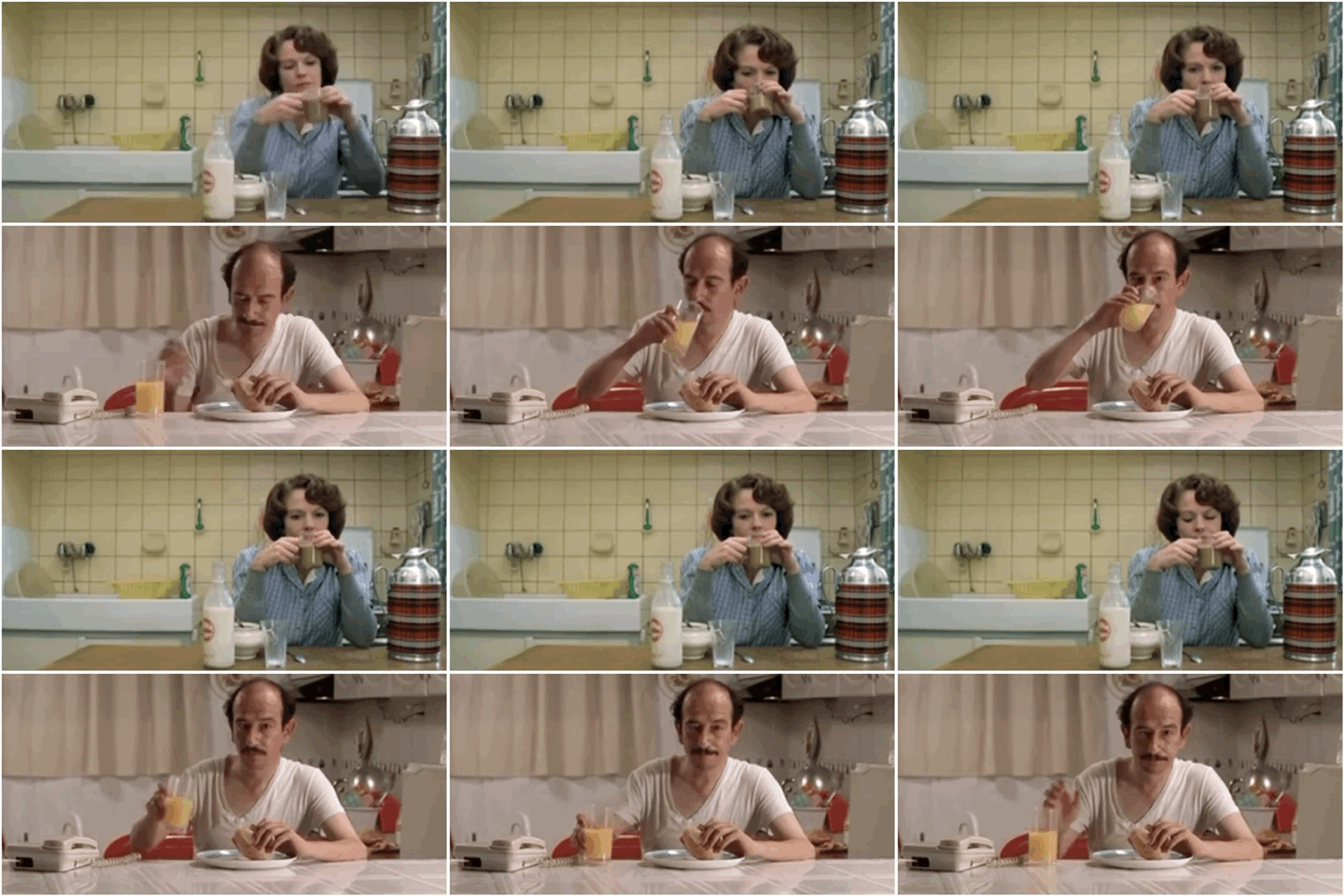
Showing posts with label mexican cinema. Show all posts

Wednesday, August 21, 2024

LOST IN THE NIGHT


This is the first time in history that I’ve watched something by Amat Escalante and didn’t walk away amazed in some way. I’m a little conflicted. Without question this might be his most beautifully shot film to date. Seriously – from the opening frame to the closing shot everything is crafted & framed as if it was shot by 70’s era Nester Almendros (lots of sunsets, magic hour, etc). Now…The basic premise is interesting but gets lost in the end.
A common theme for a lot of new releases I’ve watched this year involve the story falling apart in the second half and Lost In The Night is no exception. But regardless of how “imperfect” this may be, there’s still something special about it that got me to write down my initial thoughts. The story of Lost In The Night is about a young man infiltrating a system in an effort to solve the mystery of his missing activist mother. Naturally class divide plays a huge part in this story (like all Escalante films) but this is his most in your face film about classism & corruption in Mexico.
The problem is that by the end of the movie, the missing mother and her activism are almost forgotten about. 
Our main character is supposed to be solving this mystery/cover-up but he gets sidetracked by a love interest. Young men have historically been known to lose sight of a goal over the attention of a woman but this seems pretty egregious. I dunno…maybe I missed something?


It should be noted how, more than ever, modern architecture is used in Mexican cinema (and just modern cinema in general) to represent “evil”. I don’t like this blanket belief system that any design that’s modern equates bad or elitist or out of touch. But that’s just the modern design student in me.

When we’re introduced to the wealthy family that might have been involved in the disappearance of the protagonist’s mother, police are on the scene. There’s this subconscious association with modern architecture and criminality…
Lost In The Night

Escalante’s mentor/former collaborator also does this with Post Tenebras Lux. Our first glimpse of modern design is associated with a husband & wife having marital problems… 
Post Tenebras Lux

The Mexican film Time Share takes place in an ultra modern setting where everything goes wrong.
Time Share


Some critics have called Lost In The Night “Lynchian” but to me - it’s a combination of Carlos Reygadas meets Chantal Akerman (we seriously need to abolish the Lynchian term). I guess it's considered Lynchian by some because there's a shot like this in the film? 
Lost Highway / Lost In The Night


Escalante is on record numerous times name-dropping Akerman as a source of influence...

Whenever we shoot a film, there’s always a shot that we say, ‘oh this is the Jeanne Dielman shot,’ because there’s always someone at the sink washing dishes. It’s a sad anecdote but when we were shooting The Untamed, there’s a scene of a woman washing the dishes and we were filming her from behind. The day after that, I read on the news that Chantal Akerman had died. The day she died, we were shooting and said, ‘this is the Jeanne Dielman shot. - Amat Escalante, extraextramagazine.com
Jeanne Dileman / Lost In The Night

Jeanne Dileman / Lost In The Night

Another Akerman-esque moment from Lost In The Night...
Hotel Monterey / Lost In The Night

This does have replay value and I will certainly revisit it a few more times before the year is over. Right now I’m just a little underwhelmed. It’s like watching an A student get a B-/C+on a test. But that could all change after another viewing.

Tuesday, August 1, 2023

THE SCHOOL OF TARKOVSKY: AMAT ESCALANTE - PART TWO

Sacrifice /
The Untamed 

In this latest entry of the School of Tarkovsky, we take a deeper look at the (possible) visual connections between Tarkovsky and Amat Escalante

Click here to read part one.

Enjoy...


Sacrifice / The Untamed 

Stalker /
The Untamed 

Sacrifice /
The Untamed 

Stalker /
The Untamed

Stalker /
The Untamed

Stalker /
The Untamed

The Mirror /
Heli

The Mirror /
Heli

The Mirror /
Heli

The Mirror /
Heli

Solaris /
Los Bastardos

Andrei Rublev /
Heli
The Mirror /
Heli

Thursday, September 1, 2022

THE SCHOOL OF CHANTAL AKERMAN: AMAT ESCALANTE - PART ONE *UPDATED*


A movie that I rediscovered, because I had seen it when I was sixteen and it was quite difficult for me to see, was Chantal Akerman’s Jeanne Dielman, 23, quai du Commerce, 1080 Bruxelles. When I was sixteen, I was living in Austin, Texas, and every Tuesday the Austin Film Society would show a free film in the university. That was really my film school. I saw this film and I had never seen something like it. I went ahead in my life and kind of forgot about it, and then when I was writing Sangre I came back to it somehow and got obsessed with finding it again and watching it - Amat Escalante, extraextramagazine.com
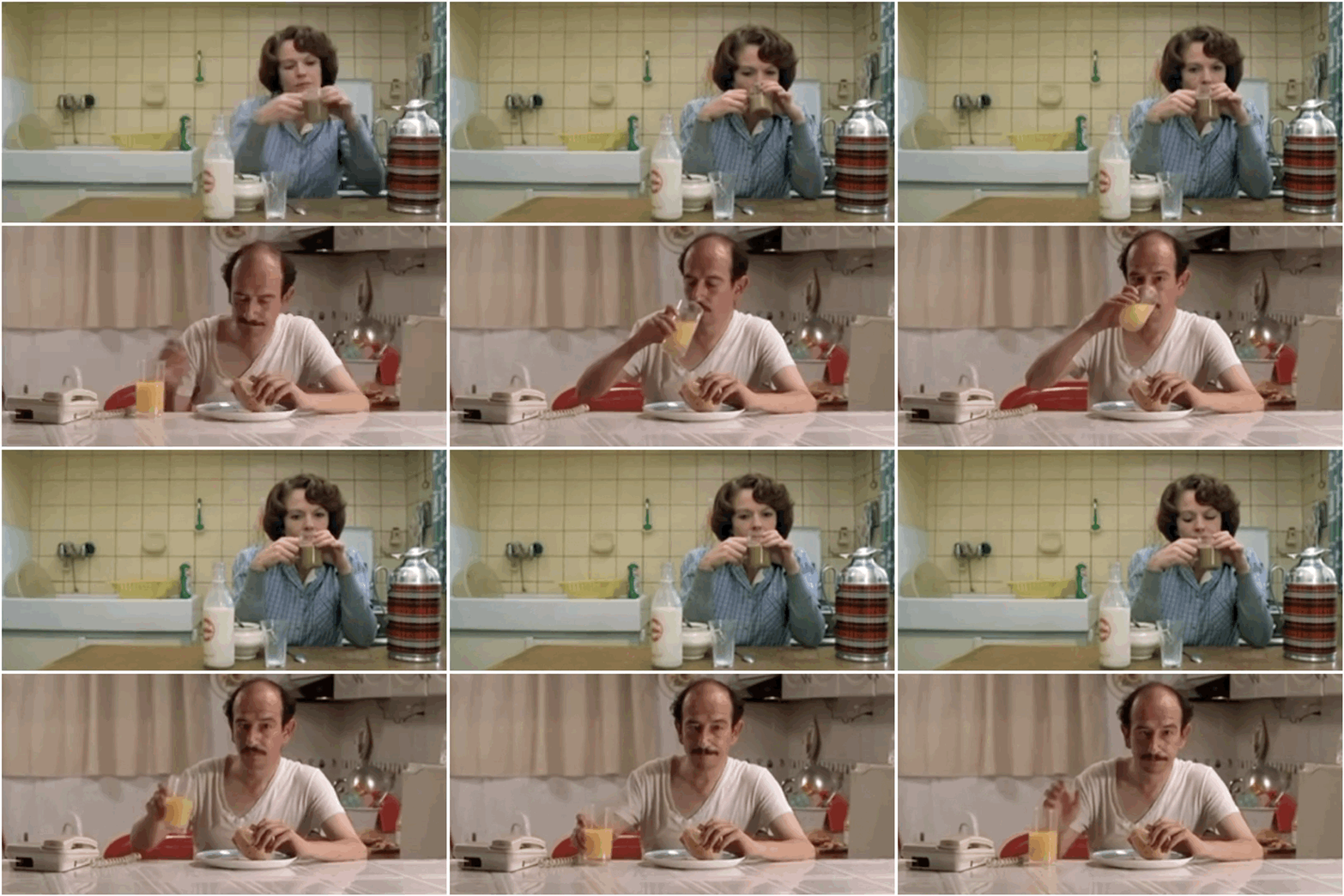
Jeanne Dielman.../
Sangre


Amat Escalante has always been open about the influence that Chantal Akerman’s Jeanne Dielman… has had on his debut feature Sangre

Jeanne Dielman.../ The Untamed

Jeanne Dielman.../ Los Bastardos


It [Jeanne Dielman] served as inspiration for my feature film Sangre - Amat Escalante, enfilme.com

Jeanne Dielman.../
The Untamed


I think there is something there that influenced Sangre especially, but all of my movies. I was happy when Sangre premiered in Festival de Cannes in 2005 because the first headline about it read ‘Jeanne Dielman Makes Tacos. - Amat Escalante, extraextramagazine.com

Jeanne Dielman.../
Sangre


I recently came across a handful of interviews where Escalante cites Jeanne Dielman’s groundbreaking film as an inspiration on his entire filmography yet there were no visual examples in any of the articles (why not just take two screenshots and put them side by side in the article to emphasize the similarity?)

So I took it upon myself to put together a handful of examples (coupled with interview excerpts) of specific moments from Jeanne Dielman that clearly rubbed off on Amat Escalante.


Enjoy…


Whenever we shoot a film, there’s always a shot that we say, ‘oh this is the Jeanne Dielman shot,’ because there’s always someone at the sink washing dishes. It’s a sad anecdote but when we were shooting The Untamed, there’s a scene of a woman washing the dishes and we were filming her from behind. The day after that, I read on the news that Chantal Akerman had died. The day she died, we were shooting and said, ‘this is the Jeanne Dielman shot. - Amat Escalante, extraextramagazine.com

Jeanne Dielman.../
Sangre


I remember for Sangre, one of the most important scenes for me was a very long shot of the guy making his eggs and then eating them. Without wanting to sound pretentious, that part reflected the meaning of the whole movie. That scene was very much about feeling a void – seeing this guy, knowing what he’s going through and the things he’s not able to do as far as loving someone in the proper way, etc. But watching him eating. And in Jeanne Dielman, that movie works with that a lot I feel. It’s not meaningless, it’s not for you to look away, its meaning and its weight have to do with all of those scenes. That’s why I get that they are not such easy movies and they’re not super popular but if you choose to be there and to look at it and live it and experience it, it’s really rewarding. - Amat Escalante, extraextramagazine.com

Jeanne Dielman.../
Sangre


Jeanne Dielman deeply impressed and influenced me - Amat Escalante, BFI

Jeanne Dielman.../
The Untamed

Jeanne Dielman.../
The Untamed

Jeanne Dielman.../
Los Bastardos

Jeanne Dielman.../
Heli

Jeanne Dielman.../
Heli

Jeanne Dielman.../
Los Bastardos

Jeanne Dielman.../
Los Bastardos

Jeanne Dielman.../
Sangre
Jeanne Dielman.../
Heli

Jeanne Dielman.../
Heli

Jeanne Dielman.../ Lost In The Night

Jeanne Dielman.../ Lost In The Night

Jeanne Dielman.../
Amarrdos


Thursday, October 1, 2020

FAUNA: TIFF 2020 HIGHLIGHT #5


It’s best to go in to Fauna completely blind (I realize saying that will immediately turn most of you away from this review, so for those of you that continue on reading my spoiler-free thoughts - I thank you). While this isn’t exactly something that you can “spoil”, it's also a film that you don’t just stumble upon (it’s a 70-minute long abstract foreign film where nothing much seems to happen). Chances are this is something that’s already on your radar.
After praising this movie on twitter and on the pink smoke, I came to the realization that I may have built up everyone’s expectations. I do stand by my overall assessment that outside of the basic plot, Fauna has touches of everyone & everything from early Amat Escalante & Jim Jarmusch, to Soderbergh’s Schizopolis & pinches of Lucrecia Martel. I’d even go so far as to compare Fauna to Yorgos Lanthimos’ underseen debut; Kinetta as both movies have the same dry low-energy/deadpan-ish atmosphere.

There’s even a brief moment that felt like an homage to a scene in Jarmusch’s Stranger Than Paradise where we get a shady exchange/hand-off...

Stranger Than Paradise /
Fauna


The Schizopolis comparison comes from the fact that midway in to Fauna, the story switches and the same actors from the first section of the film play completely different characters in the last half (like Soderbergh & Betsy Brantley in Schizopolis).
Nicolas Pereda even goes so far as to make the actors in Fauna wear intentionally bad wigs just like Soderbergh did in his film...

Schizopolis / Fauna

Schizopolis / Fauna


But don’t expect the outward silliness of Schizopolis or the creepy surreality of The Untamed (Escalante) or Zama (Martel). If anything, it’s like the banal & “boring” parts from all the aforementioned films mixed in to one subtle movie mixtape. Considering what the film is “about”, I think director Nicolas Pereda made an intentionally boring film to throw the audience off. Every synopsis about Fauna on the internet focuses on Perada’s commentary about drug trafficking & drug culture and it’s negative effect on Mexico (recent stuff like Sicario, Narcos, etc).
When the average person thinks of those things they probably imagine coke deals, shootouts, throat-slitting etc. Fauna has absolutely none of that. Actually, Nicolas Pereda’s criticism of the romanticization of Mexican drug culture doesn’t even come in to play until the last 30 minutes and the film is only 70-something minutes to begin with (there is a brief moment early on in the film where he addresses a Narcos-like show but you don’t even realize the importance of that moment until the very end).


I appreciate Nicolas Pereda essentially trolling audiences (in the most mature way one can troll) who are/were expecting scenes of Uzis & AK-47s or drug kingpins surrounded by cocaine bags and instead he gives us an almost Chantal Akerman-esque story of two sibling going off to the Mexican countryside to visit their parents (while there are some outright criticisms of the romanticization of drug culture on Mexico, the bulk of the film is an intentionally “boring” and somewhat awkward family reunion).

Fauna is most certainly an acquired taste. It feels like the equivalent of going to see a traditional stand-up comedian but getting Neil Hamburger or Andy Kaufman instead. If you like Hamburger or Kaufman then great! If you don’t, you’ll probably walk out 15 minutes in to the show.

Friday, October 25, 2019

THE SCHOOL OF TARKOVSKY: CARLOS REYGADAS PART ONE

Cinema is the art of reality, the medium in which reality’s beauty is captured, where you can film marble or a face, or record someone’s voice, a sunset, the innate beauty of what you’re contemplating. Tarkovsky achieved this - Carlos Reygadas (Bomb Magazine)

Solaris /
Japon


With Tarkovsky, I was seeing something made from reality itself, reality was transformed into a form of beauty, conveying so much feeling. - Carlos Reygadas (Burnaway)


We can go on and on with quotes and citations of Carlos Reygadas name-dropping Andrei Tarkovsky as a major influence on his career over the last two decades, OR, you can use your eyes and check out the examples below.

It's no mystery that Carlos Reygadas has pulled from directors like Carl Theodor Dreyer, Luis Bunuel, Arturo Ripstein and more. But at the end of the day, Tarkovsky is his number one influence. Below are some of my favorite examples of the visual & thematic similarities between Andrei Tarkovsky & Carlos Reygadas.

Enjoy...


When I was about 15, my father gave me a Tarkovsky film on VHS and I was amazed at the simplicity, the power that comes out of a single event. I’m not very much into narrative-driven films and I never remember dialogue; what sticks in my mind are the sound, the image and the camera movement. With Tarkovsky it’s as if direct emotion comes out of each image and sound. It drives me crazy - Carlos Reygadas (Sight & Sound)


Ivan's Childhood / Post Tenebras Lux


The title [Our Time] refers to the unfolding of events in time, which is, as Tarkovsky suggested, the third dimension of cinema - Carlos Reygadas (Film Comment)
Solaris /
Our Time

Andrei Rublev /
Our Time

Solaris / Battle In Heaven

Solaris / Japon

Andrei Rublev / This Is My Kingdom

The Mirror / Silent Light

Solaris / Battle In Heaven

Ivan's Childhood / Post Tenebras Lux

Solaris / Silent Light

The Mirror /
Post Tenebras Lux

The Mirror / Post Tenebras Lux

Ivan's Childhood /
Post Tenebras Lux

Solaris /
Japon

Stalker / Post Tenebras Lux

Ivan's Childhood / Post Tenebras

LinkWithin

Related Posts Plugin for WordPress, Blogger...