Upgrade is one of those movies that’s totally fine but you’d think it was my favorite movie based on how I talk about it and defend it all the time. I know that doesn’t make complete sense but that’s the only way I can describe it. This is the true definition of a comfort film. There’s nothing original about the story but the execution is just right. I think media consumption is suffering because a lot of people have this expectation that a movie has to be an instant classic before the final credits role. If the impact isn't felt immediately then the movie is treated like a disposable piece of nothing. Sometimes it's ok for a movie to be fun/entertaining and grow on folks over time. This has been relationship with Upgrade. I never get tired of watching it. Imagine the basic plot of Robocop with a few tweaks, more “bisexual lighting” and a fraction of the budget.
In the film, Logan Marshall Green plays "Grey Trace" - a recently widowed and disabled auto-mechanic that agrees to be the guinea pig for a controversial procedure, “STEM”, that will allow him to walk again. As the movie unfolds we learn that Trace’s paralyzation, STEM and the death of his wife are all connected.
The Robocop comparisons are super obvious but Upgrade director Leigh Whannell made a point to mention the similarities himself...
Robocop / Upgrade
With Upgrade, there's certainly a nostalgia there associated with '80s sci-fi films that I grew up with, like Robocop - Leigh Whannell, Vulture
Robocop / Upgrade
Besides the basic premise of a man turned in to a half human/half robotic killing machine, there are some very specific moments/beats between the two films that go beyond basic nostalgic influence.
Robocop / Upgrade
Some of the key similar moments between Robocop and Upgrade are even shot the same…
Robocop / Upgrade
Upgrade was also understandably compared to Venom as both movies were released the same year, each focusing on characters losing control of their bodies to some sort of outside/alien force (it should also be mentioned that Logan Marshall Green and Tom Hardy kind of look alike).
Upgrade / Venom
The movies that inspired me are the movies that I always loved. Films like the original Terminator, which is one of my favorite films. RoboCop, The Thing - Leigh Whannell, thenerdstemplar.com
Terminator / Upgrade
The Thing / Upgrade
I'm always a little apprehensive to compare anything to David Cronenberg. The older I get the more I'm finding that a lot of people don't exactly understand his films and/or his ideologies, but...Whannell does mention him as a major inspiration. Outside of the basic "gore" element, there is a very surface-level Cronenberg quality to certain aspects of Upgrade...
Cronenberg is a seminal filmmaker for me. I love the topics he covers: this messy world of the body. He finds the human body horrific, and all of his stuff gets tossed into the soup of my subconcious. Videodome, eXistenz, movies like that are there, and being able to draw on those influences is great. Usually, when I'm writing, what I do is I go, "OK, so you've got this sort of Cronenberg/Terminator thing going on. What are you gonna do with it?" - Leigh Whannell, Birthdeathmovies.com
Videodrome / Upgrade
eXistenZ / Upgrade
And I know almost every movie can be connected to Stanley Kubrick in some way, but as Upgrade unfolds, "Stem" starts to act just like Hal from 2001...
2001... / Upgrade
The subject matter of Upgrade was certainly prescient given the rise of artificial intelligence everywhere (it seems like so much of what we read and deal with online and in academia has become a hybrid of the human element mixed with AI). All the elements for a great essay on the parallels between Upgrade and modern AI are there. I’m more interested in this film on an entertainment level. It’s just a fun action sci-fi story with a great droany score. It has to be noted that the music for Upgrade is great and works as a standalone entity. Jed Palmer’s score would mix in perfectly between early 90s Autechre and modern-day Brian Eno.
My only complaint is that there wasn’t a part two. I know it can get tiring having to deal with non-stop sequels and “cinematic universes”, but in the case of Upgrade it makes sense. Not to spoil the film too much but the final moments of Upgrade end on a sort of cliffhanger. Sure not everything needs a sequel and you could use your imagination to think up your own Upgrade cinematic universe, but I wanted to see it for real. *SPOILER* - the movie ends with STEM taking over Trace’s body and turning him in to the villain. At the same time - the police officer that’s tasked with trying to stop Trace/STEM is left paralyzed/immobile and in the perfect position to have a similar STEM-like procedure done to her in order to track down the new rogue STEM/Trace). While Upgrade didn’t break any box office numbers, it still made a $14 million dollar profit off of a $3 million dollar budget and gained a small but dedicated cult fanbase. On one hand, I know Blumhouse has bigger priorities but I can’t imagine it would have been that much of a gamble to make a sequel.
Perhaps Upgrade should have been a direct-to-video release from the start. This way we would have definitely got a sequel like all the Scott Adkins and Michael Jai White DTV films that maintain a dedicated fanbase.
This is hardly a masterpiece but it remains one of my most revisited films of the last decade.
If you’ve been a regular reader of this blog for the last 7-8 years then you know the constant negative criticism I have of cinema in general is that most movies appear to be made out of surface level twitter activist talking points for Twitter activists to debate about on Twitter. It’s all so formulaic and anti-art. Genuine art and coherent stories takes second and/or third place on the checklist of forced representation, pandering, catering to every possible personal problem, etc. Eddington is absolutely one of those movies. But it kind of work this time! It plays out like a director poking fun at someone’s overly sensitive chronically online fever dream. Kind of working is saying something considering most movies these days do not work for one reason or another (pandering to the audience, not looking/feeling like an actual movie, really stupid plot twists, etc). I don’t think a movie like Eddington can totally please everyone or totally hit every mark but I respect Ari Aster for taking the big swing and getting a good piece of the ball.
Yes this is a Covid movie set during the height of the first wave of lockdown. Yes it touches on issues like empty disingenuous BLM activism perpetuated by young white people and the fake outrage/care that conservatives have when it comes to wearing a mask or protecting abused children. But it works. It works because Ari Aster doesn’t actually take a side. Some have called Eddington's approach "centrist" but I don't see it that way. He shows just about everyone as a fake bullshit artist.
Who and what is being poked fun at or referenced in Eddington is obvious…
While Eddington is somewhat different from the rest of Aster’s films, his regular cinematic influences and references are still there…
Psycho / Eddington
Lost Highway / Eddington
Robocop / Eddington
At its core - Eddington is about the disingenuous political motivations between two people that just don’t like each other. On one side you have the pretentious Democratic mayor that thinks he’s above everyone. On the other side you have the local sheriff who decides to run against the current mayor because he’s sick of all the Covid mask mandates. As the film unfolds we discover the real motivation behind each side’s campaign. Besides the classic “right versus left” rivalry, Aster injects subplots concerning Qanon, cultism and BLM activism headed up by all white people.
There’s literally a scene in the movie where a white liberal activists tells a Black police officer how to feel about anti-Black racism. If that doesn’t sum up a huge part of the current social political climate I don’t know what does (it should be noted that there is a certain type of liberal/left-leaning Black person that is to blame for allowing liberal white people to speak out of pocket to Black people about the Black experience).
This scene really stood out to me because I grew up in a town where white liberals/left-leaning folks could sometimes get a little too comfortable speaking deeply on cultural issues that don’t concern them. I don’t really care for police (Black police at that) but I’ll be the first person to side with that Black cop if it’s between them and a clueless white liberal that thinks they can brow beat another Black person about Black issues.
*UPDATE*
Well, well, well. Whatdya know...
For those that are unaware, a Black ICE agent was called a "house n*gger" recently by a protestor and it was caught on camera. This sort of mimics the scene in the film and proves my point. In no way do I support ICE, but I also don't support anyone calling a Black person a "house n*gger".
The only reason I even bothered to finally watch Eddington is because it’s being compared to One Battle After Another in an abstract kind of way. Folks are comparing the two movies under the umbrella of “definitive movies representing the current state of America”. I figured Eddington has to be better than OBAA (click here to read my rant on One Battle After Another). I understand the comparison between the two movies in a coincidental kind of way. Both are set in the American west which, when shown a certain way, can be a very old timey American setting that calls upon a certain type of nostalgia only Americans can relate to. Neither movie is a traditional western but they do take from the genre on a surface level (snakeskin boots, Cowboy hats and shootouts in the desert). Both movies also have tense explosive finales. In my opinion, Eddington is a far better film than OBAA because Ari Aster pokes fun at some of the people that Paul Thomas Anderson desperately tries to pander to in his film.
It also took me a while to watch this because I’m not in to Ari Aster’s movies. I have a weird personal vendetta against the large majority of Ari Aster’s filmography (please note that I said personal). I came from a good family, grew up around good families and I’ve produced a new generation of a good family. I like healthy upbringings. So I’m not really a fan of the “families mess us up, don’t they??!” I especially don’t like the type of overly heightened/romanticized films in that genre that Aster has given us so far. I’m not denying that family absolutely can and sometime does cause mental illness, trauma, harm and all the other standard online therapy keywords people use. It’s just not interesting to me. Especially when it gets co-opted by people with no personality outside of “my parents messed me up” when in reality they had a pretty solid upbringing (these people exist). So it makes sense that I like this! It’s so much different than Hereditary or Beau Is Afraid or aspects of certain aspects of Midsommar.
Eddington is far from perfect but I really liked it. Unfortunately, and this isn’t really the film’s fault, Ari Aster gives the audience a little too much credit and assumes they’re smarter than they really are. I think folks without nuance or an understanding of middle ground or grey area could watch this movie and walk away with the wrong idea about most of the characters in the movie with the exception of Austin Butler’s “Vernon” who is clearly a scumbag predator the minute he shows up on screen.
In summation - this is the movie that everyone thinks One Battle After Another is.
I went in to this with low expectations and came out pleasantly satisfied. Rose Glass’ sophomore feature didn’t break any new ground but it’s certainly a solid popcorn movie. I think some people are eager to make this out to be something more than it is due to the sexuality within the film but at the end of the day it’s nothing more than a fun crime story. And that’s totally fine. Contrary to what a lot of critics try to push nowadays, some movies exist for entertainment and/or a momentary escape. Everything isn’t some radical or political statement. On a surface level, Love Lies Bleeding rests somewhere between the cinema of Nicolas Winding Refn and a more polished/mimicked iteration of early Gregg Araki. I was eager to compare this to stuff like Wild at Heart & Thelma & Lousie but Glass herself made a point to avoid tapping in to those films. Also, making that kind of comparison is like calling something that’s slightly weird; “Lynchian”. It’s cheap.
Speaking of cheap and things being incorrectly labeled as “Lynchian” – there is a shot of a dark road at night in Love Lies Bleeding so I’m sure some critics jumped at the chance to compare it to Lost Highway.
Because so much of the DNA and ingredients of [Love Lies Bleeding] is so easily connectable to so many other films — Wild at Heart, Thelma and Louise, True Romance, anything with two lovers with guns and murder in extremity — I was wary about not wanting it to [revisit them] – Rose Glass, Hollywood Reporter
At this point, a movie like Thelma & Louise is so popular that you can’t avoid some type of subconscious influence but there’s no unique connection between the two films outside of the desert and two women kind of on the run…
I've never seen Thelma and Louise but that's so famous that even if you haven't seen it, you sort of feel like you have, so I'm sure it has an influence somewhere – Rose Glass, Theskinny.co.uk
Again – this feels like it was birthed from someone trying to pay homage to Gregg Araki with way more budget and a bit less grit. That may sound a little harsh but even with criticisms like that, I really did enjoy Love Lies Bleeding overall. I couldn’t find any interviews where Glass name-drops Araki as a source of inspiration but some of the similarities in the movie, intentional or not, are undeniable…
Doom Generation / Love Lies Bleeding
While the basic romance/crime story has been done before to some degree, Glass throws in things like female bodybuilding and random moments of surreality to try and stand out from other sweaty cigarette stenched crime capers (if you’re looking for a more direct comparison, Love Lies Bleeding is definitely a first cousin to something like Bound). There are a handful of scenes in this movie that seem a little random for the sake of being random but I’m honestly not mad at that.
This story is set in the 80’s and for someone not even born in that decade, Glass does an excellent job of not falling in to the trap of dressing all the characters up in neon windbreakers & rayban sunglasses. It seems like whenever a filmmaker wants to set a film in the 80s, the first thing they do is make everything neon & cheesy. The 80’s was not all MTV, Boy George & Madonna. I was born in 1981. My memory of the 80’s was a lot of cigarette smoke, ugly carpets (that trapped in all the cigarette smoke) and the color palettes were often browns & oranges as apposed to neon pinks & yellows. Again – Love Lies Bleeding has a bit too much sheen for a seedy 1980’s Reno, Nevada crime story, but there is a genuine attempt at trying to capture the 80s. The smells, the ashtrays, the faded jeans, etc…
The small handful of cinematic references that Glass openly pulls from are also a bit outside of the box. Instead of the aforementioned Thelma & Louise or Wild At Heart, Glass pulls from sources like Paul Verhoeven and 1960s B-movies. These influences are even more interesting to me because her first film, Saint Maud, pulled from folks like Bergman & Polanski (a lot of people claimed there was Tarkovsky in Saint Maud but according to Glass, she wasn’t very familiar with his work at the time).
Showgirls was just one of those films that I remember watching when I was probably too young to watch it quite late one night on TV - Rose Glass, The Hollywood Reporter
Showgirls / Love Lies Bleeding
Attack Of The 50 Foot Woman / Love Lies Bleeding
Contrary to what one might assume, the Refn similarities lie in the music and the random spurts of violence and not the fascination with trying to replicate the 80’s as some sort of Andy Warhol/David Lachapelle/pop art fever dream.
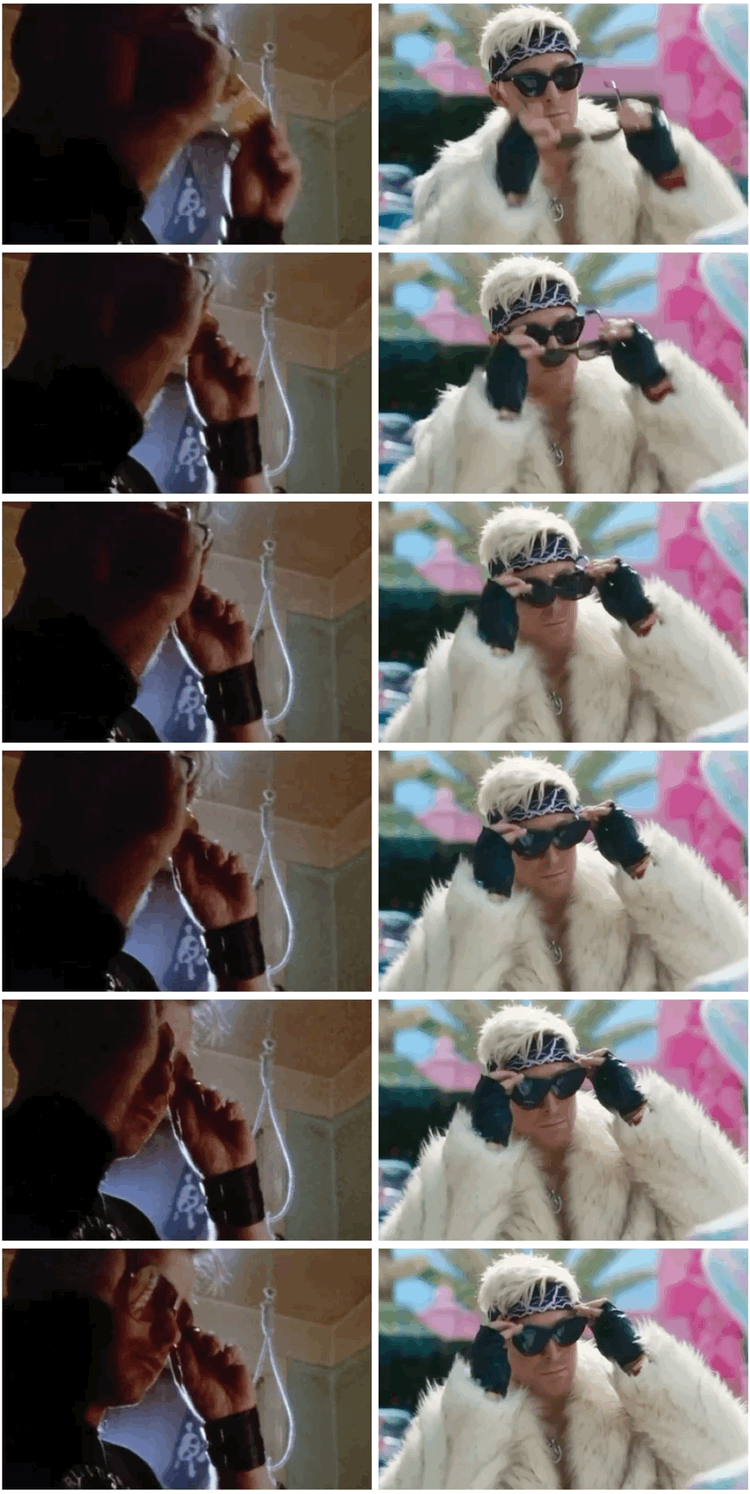
Now that some of the hype has died down I wanted to highlight some slightly left field comparisons I found between Greta Gerwig’s Barbie and a handful of films that were not name-dropped by Gerwig during her press run. I have nothing to add to the actual discourse of the film. I enjoyed it but there are already tons of essays & reviews regarding gender roles, the patriarchy, misogyny, “film bros”, etc. I have nothing unique to add to that conversation.
Now…for context, Gerwig sat down with letterboxd and highlighted a long list of movies that influenced the visual style of Barbie (Jacques Demy, Jacques Tati, Victor Fleming, Kubrick, etc etc). Click here to check out the video.
I don’t feel the need to highlight these comparisons because they’ve been run in to the ground.
What I’m presenting are coincidental visual similarities to movies that haven’t really been mentioned that may or may not have made some kind of subconscious impact…
Barbie / The Unbelievable Truth
I realize that I’m opening up the door for comparisons to any movie with a splash of pink in it but that’s not what I’m trying to do here. I guess I’m just trying to throw out the possibility that so-called “arthouse” or underrated/under appreciated films may have left a sliver of lasting DNA on pop culture…
Georges Melies is kind of a default influence on pretty much all of cinema considering he was one of the earlier filmmakers. A lot of that default influence is all over Barbie...
Voyage To The Moon / Barbie
The Eclipse, The Courtship of the Sun and Moon / Barbie
The Mermaid / Barbie
Same applies to folks that came after Melies like Ernst Lubitch...
The Doll / Barbie
The Doll / Barbie
A possible Matrix reference?
The Matrix / Barbie
Which could also be a Total Recall reference...
Total Recall / Barbie
Gerwig is a major fan of Chantal Akerman, so Akerman's most colorful & playful film rubbing off on her isn't too farfetched...
Golden Eighties / Barbie
Douglas Sirk wasn’t a name I remember Gerwig namedropping but her use of pink is quite reminiscent of Sirk’s…
Written On The Wind / Barbie
And, naturally, other filmmakers who borrowed from Sirk (Todd Haynes, Fassbinder, etc) came to mind when thinking of Barbie…
Barbie / Vlevet Goldmine
Superstar: The Karen Carpenter Story / Barbie
Lola / Barbie
Lola / Barbie
Lola / Barbie
The Wizard Of Oz is one of the biggest influences on Barbie (I don’t think this is any revelation). So naturally other Oz-influenced movies are going share visual similarities with Barbie…
Wild At Heart / Barbie
I’m not a film analyst but most of the things we do nowadays, also in advertising, lead back to Kenneth Anger’s work - Nicolas Winding Refn, Indiewire
This quote also kind of applies to Barbie…
Fireworks / Barbie
Kustom Kar Kommandos / Barbie
Elvis’s music (and rumors about his sexuality) are associated with Kenneth Anger’s film so I don’t think it’s a reach to compare some of the dance numbers in Barbie involving the Kens with Elvis (naturally the dance sequence on the right brings Grease to mind but a lot of music and dance sequences in Grease can be traced back to Elvis)
Jailhouse Rock / Barbie
This is also interesting because Refn, who was synonymous with Ryan Gosling for a couple of years also borrowed heavily from Kenneth Anger (click here to read more).
It was another great & somewhat diverse year in the "Cinema Of..." series. In an effort to save you some time, I compiled them all in to one post (click each of the images to go to the individual pieces).