For those that don’t know - I’m not only from western Massachusetts but I’m a former classmate of Janet Planet director Annie Baker (not trying to name-drop. I just think it would be odd to not mention that). I don’t think my opinion on this movie holds more weight than anyone else who’s seen it, but I think I know the basic material more than the average person. Not the deeper coming of age story of an 11 year old girl and the close relationship with her quietly eccentric mother. But all the ancillary elements are very near & dear to my heart. It’s impossible for me to not feel nostalgic watching this. The first time I saw it I spent half the time pointing out to all the very real places I grew up in & around. Amherst is a very unique place. I know everyone with some kind of hometown pride always says that about wherever they’re from but people that aren’t even from Amherst that have spent time there have confirmed that it’s unlike anywhere else. It’s incredibly liberal (sometimes laughably liberal when compared to the rest of the world) and sometimes pretentious but well-meaning at the end of the day. I couldn’t imagine growing up anywhere else. Amherst is where I learned about weird movies and music which is a huge part of who I am today. I can confirm that this movie captures the vibe of early 90’s Western, Mass. The wooded areas, the architecture, the clothes, the aging hippies — all of it.
It’s just nice to see specific landmarks that you grew up with in a movie directed by someone that’s actually from where the story takes place. If you’re from places like Toronto, Los Angeles, Boston, Philadelphia, Chicago or New York City - it’s fairly common to see familiar landmarks show up in movies. That’s not the case when you’re from Western Massachusetts. We’re usually an afterthought or incorrectly attached to the other side of the state. So much of our personality is based on telling non-new England folks that we aren’t from Boston or that we’re different from Boston people. …At least that’s how it was for me post-high school (to be clear - we are very different from the people on the eastern side of the state in that we’re less aggressive and aren’t as angry).
Mount Pollox Conservation Area, Amherst Massachusetts
The parking lot of the Hampshire Mall, Hadley Massachusetts
Tobacco barn in Hadley
Masonic Street Mural, Northampton Massachusetts
A huge chunk of this movie's personality is the result of watching & appreciating a wide range of cinema and paying homage to it. I mean that in a good way. There’s lots of visual references in this. It wouldn’t be out of line to program Janet Planet on a double bill with something like Fanny and Alexander or Welcome To The Dollhouse (a film that co-stars Amherst alumni; Eric Mabius). Annie Baker subconsciously borrowed from movies in that lane. That’s actually what I liked most about her film. If you’re familiar with this blog then this shouldn't come as a surprise. That's all I seem to care about with movies these days. This is very much her own unique vision but she’s been very open about her cinematic inspirations. I caught some immediately without having to do any research. Others I learned about through reading interviews and listening to Q&As. Some of the comparisons below might seem a little forced or vague, but I think I captured the ones that are most key/important:
Watching it gets you in touch with all the times you've felt horribly depressed and also overwhelmed by the beauty and color of everything around you - Janet Planet, Criterion
Documenteur / Janet Planet
I’ve seen this movie [Fanny and Alexander] more times than I can count. I think it’s the best movie about being a kid ever made. It’s a fairy tale and a nightmare and a totally believable portrayal of a Swedish family in Uppsala at the turn of the twentieth century, all at the same time. It has always reminded me of one of my favorite novels, Thomas Mann’s Buddenbrooks. It’s also a movie about the weird magic of theater . . . Both the opening sequence and the reading from Strindberg at the end kill me. And the way Bergman shoots inanimate objects . . . The statues and the toy angels and the clocks and the puppets and the lamps . . . They’re all watching Alexander, the whole movie - Annie Baker, Criterion
Fanny and Alexander / Janet IPlanet
Fanny and Alexander / Janet IPlanet
Fanny and Alexander / Janet Planet
I saw this when I was twenty-five or twenty-six and really confused about my work. I was so discouraged and had stopped writing, and this movie made me excited to start working again. Akerman was doing something with pace and composition and time that I'd always wanted to do but had been too chicken to acknowledge or go toward. Watching this made me realize that you should make the kind of art you want to see, which sounds kind of obvious but was a big revelation to me at the time- Annie Baker, criterion
Jeanne Dielman... / Janet Planet
Jeanne Dielman... / Janet Planet
growing up in Amherst, Mass., in the '80s and '90s, you see a lot of political puppet theater - Annie Baker, The New York Times
The Meadows Green / Janet Planet
The Meadows Green / Janet Planet
Dead Man Rises / Janet Planet
The filmmaker I would say my D.P. and my editor and I discussed the most was Maurice Pialat, especially his film "L'Enfance Nue." Another movie that is very important to me is [Victor] Erice's "Spirit of the Beehive." We also talked about [Abbas Kiarostami's films about children, and my sound designer Paul and I talked a lot about [Apichatpong] Weerasethakul, and went to see "Tropical Malady" together - Annie Baker, The New Yorker
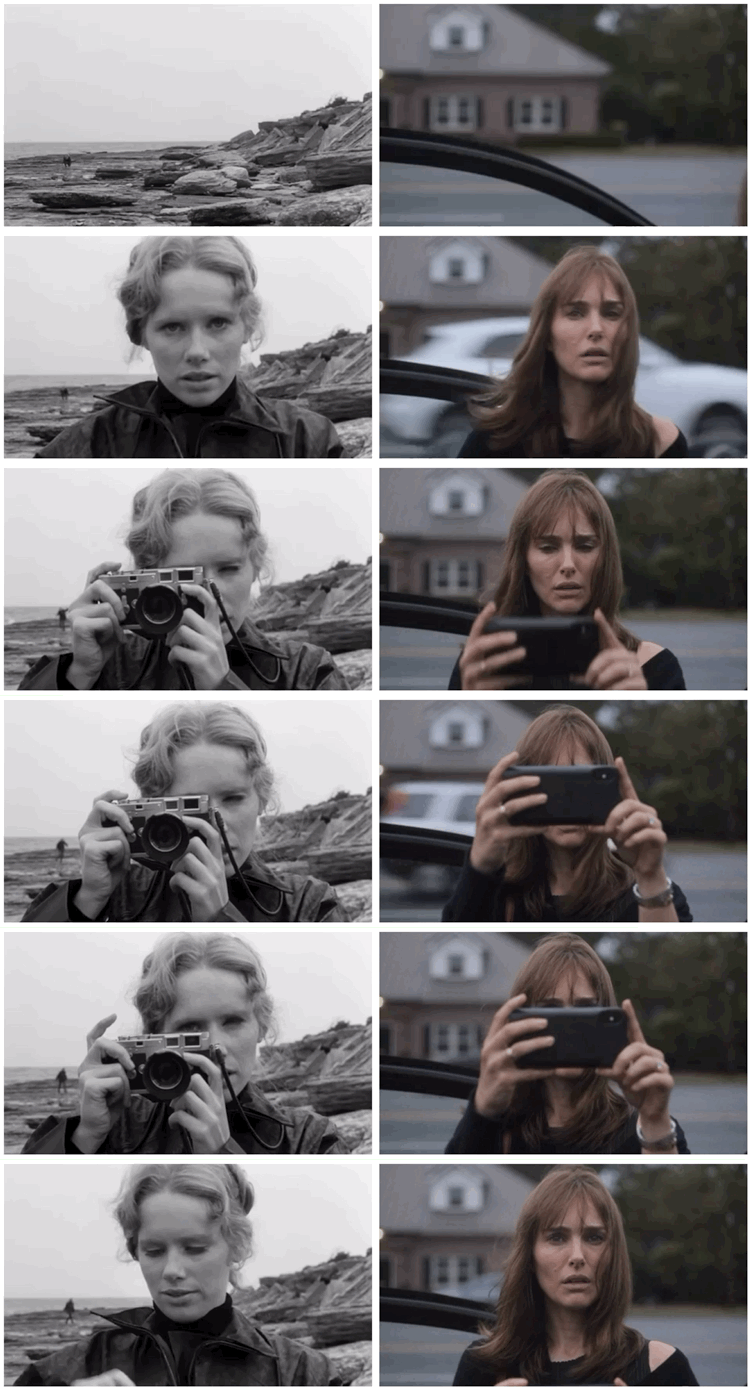
I couldn’t not think of Persona when I first read Samy’s script, in the clear way that it’s such a unique example of a film that pairs these two women and where likenesses are being exchanged, or that one character is learning about the likeness of the other and trying to incorporate her into her process as an actor - Todd Haynes, Letterboxd
'
Persona / May December
I caught a handful of Persona-esque shots in Todd Haynes May December only to discover afterwards that it was intentional (click here to learn about Haynes' influences on his latest film). Normally, a filmmaker being influenced by one of Bergman's most recognizable films seems like low-hanging fruit but this is the first time Haynes has been so open about Bergman's influence (he usually draws from the likes of Chantal Akerman, Douglas Sirk, etc).
Below are all of the worthwhile references/similarities I caught (some super obvious and others not so obvious).
And in Persona, Liv Ullmann plays an actress who’s been stricken with stage fright and has stopped speaking. Bibi Andersson is a nurse and a caretaker, called in to look after her - Todd Haynes, Letterboxd
Persona / May December
That shot figures into the film Persona, but it’s not necessarily the shot you think of when we all think of Persona. The ultimate shot is where these two are almost playing as if they’re in a mirror, and their gaze turns to the lens of the camera. It’s like a dream - Todd Haynes, Letterboxd
Persona / May December
Persona did influence that scene directly - Todd Haynes, Letterboxd
Somewhere between Robert Altman’s Images and Robert Eggers’ The Lighthouse lies Mark Jenkin’s Enys Men – an intentionally ambiguous psychological horror about mental illness, past traumas and the handling of grief. I also believe this movie touches on the psychological effects of long-term loneliness and isolation. The story takes place in the early 1970's but the residue of Covid is all over this. If “post-Covid cinema” is a thing then this definitely falls under that label (it was shot during the back end of the first wave of the Covid-19 lockdown).
Enys Men also belongs to the semi-recent “Persona-sploitation” category next to movies like Always Shine, Slow Machine, The Clouds Of Sils Maria and more…
Persona was the first Bergman film I saw. It blew my mind then, and I keep going back to it - Mark Jenkin, Criterion
Persona / Enys Men
I think it’s lazy to write this movie off as simply “pretentious” or “lo-fi horror” (these are things some critics have written about it). I understand not liking something. It’s completely understandable to not like Enys Men. But there’s more to it than just pretentiousness which seems to be the go-to critique when something is slow or doesn’t follow a set rules. Personally, I just find myself drawn to “complicated” movies and Enys Men is certainly that…
On one hand, this is the kind of horror/psychological drama one would expect from Neon studios. The type of horror story made for folks that like to romanticize trauma and connect everything back to grief. If I wasn’t aware that this was a Neon film beforehand I would have assumed it was put out by A24.
There’s a lot of recent talk about the look and overall aesthetics of modern independent cinema and Enys Men is a prime example. It plays right in to that lane of modern horror movies that’s more interested in being mysterious rather than outright terrifying. Instead of quick jolting jump scares we get a lot of slow jump scares (?) if that makes any sense. I can’t quite put in to words - which is hilarious to say within a written piece - but so many movies under the A24 & Neon banners have that same aesthetic/vibe. Men, It Comes At Night, Lamb, Woodstock, Saint Maud, etc etc. Droany music, ambiguous plots, small casts, sometimes-beautifully shot minimalist settings/backdrops, etc.
Images / Enys Men
The Lighthouse / Enys Men
Enys Men is so vague and abstract that it can have an infinite amount of meanings. As the film unfolds we get a series of unreliable edits & flashbacks of some tragedy that took place in the past. Because the “plot” is so evasive I find myself drawn to the imagery more than anything else. And that’s fine. I’m not too caught up in the “meaning” of things. But even with the short 90 minute run time, after a while it feels like this should’ve just been a short film (imagine a 90 minute version of Maya Deren’s Meshes Of The Afternoon).
But…if Enys Men was a short film then we wouldn’t see all of the intentional Deren-esque/Akerman-esque repetition that Jenkin tries to highlight. Throughout most of the movie we see our female protagonist perform the same daily tasks over and over...
Meshes Of The Afternoon / Enys Men
Meshes Of The Afternoon / Enys Men
Meshes Of The Afternoon / Enys Men
Jeanne Dielman... / Enys Men
Jeanne Dielman... / Enys Men
Jeanne Dielman... / Enys Men
In addition to Altman’s Images, Persona, etc, Mark Jenkins takes a few visual cues from Nicolas Roeg’s Don’t Look Now. The red coat worn bout the film’s protagonist comes off as an homage…
Don’t Look Now is the obvious choice. Roeg’s influence runs through everything that I’ve done as a filmmaker - Mark Jenkin, Criterion
Don't Look Now / Enys Men
I also love his use of zoom lenses, which informed the way I shot Enys Men - Mark Jenkin, Criterion
Don't Look Now / Enys Men
Don't Look Now / Enys Men
Don't Look Now / Enys Men
Don't Look Now / Enys Men
An entire separate comparative study could be done on Takovsky's influence that flows all throughout the film...
For me, Tarkovsky’s films exist outside of time and space. I can’t imagine how a film like Mirror sat within the cinema of its time - Mark Jenkin, Criterion
The Mirror / Enys Men
The Mirror / Enys Men
Stalker / Enys Men
The Sacrifice / Enys Men
Stalker / Enys Men
Ivan's Childhood / Enys Men
Solaris / Enys Men
The Mirror / Enys Men
We’re only a couple hundred words in to my thoughts and I cant even make it this far without a bunch of comparisons. This could very well be a case of lazy writing/analysis on my part but if you’ve seen Enys Men and are familiar with my reference points thus far – I think you’ll understand where I’m coming from. Before the 10 minute mark you’ll be able to catch every reference I’ve called out and more. But that's part of what draws me in. Anyone familiar with this blog knows I'm a sucker for homages & references and this movie has plenty. Also - Mark Jenkin does not shy away from shouting out his influences (read Mark Jenkin’s criterion picks for a better understanding of how open he is about his influences).
It’s a bit of a cliché, but I tend to connect Bresson, Tarkovsky, and Bergman - Mark Jenkin, Criterion
Persona / The Mirror / 4 Nights Of A Dreamer / Enys Men
L'Atalante / Enys Men
Now…there were reference points I did not catch until reading about the film afterwards which helped me to reappreciate what I had just seen.
I like to normally use a single 26mm lens on a 60mm camera, so the equivalent of a 50mm lens like Ozu or Bresson – Mark Jenkin, Ukfilmreview.co.uk
Woman Of Tokyo / L'Argent / Enys Men
I like the idea of a horror film being influenced by non-horror reference points like Ozu and Bresson…
Early Summer / Enys Men
The opening shot of Enys Men is an homage to a composition of an ATM that appears in L’argent. It’s the kind of thing that no one would ever pick up on but that I know - Mark Jenkin, Criterion
L'Argent / Enys Men
Jenkin instructed his main actors to perform in the deadpan/Bressonian style:
What I try to take from Bresson is his attitude toward performance - Mark Jenkin, Criterion
Pickpocket / Enys Men
I can’t articulate what effect Bresson’s films have on me, that’s the beauty of it – Mark Jenkin, Ukfilmreview.co.uk
Diary Of A Country Priest / Enys Men
Mouchette / Enys Men
L'Argent / Enys Men
And I hate doing this but there are some legitimate Shining comparisons. But it’s not what you’d expect. Instead of creepy children and endless shots of hallways – the film’s use of communicating through transistor radios reminded me of The Shining.
The Shining/ Enys Men
There are some other vague Shining-isms throughout the film...
The Shining / Enys Men
The Shining / Enys Men
With reference points like Akerman, Ozu & Bresson – you can imagine this movie tests the audience’s patience. It didn’t test mine because I like slow movies more and more these days, but I wouldn’t fault anyone for complaining that this was too “slow” or “boring”. But to be fair to the director – this isn’t exactly the kind of movie that someone just blindly watches. Some movies are intentionally alienating and made with an exclusive audience in mind. I think Enys Men is one of those films. If you're a fan of all the movies I namedropped in this review - then perhaps this is something for you to check out.